Tuesday, June 19, 2012

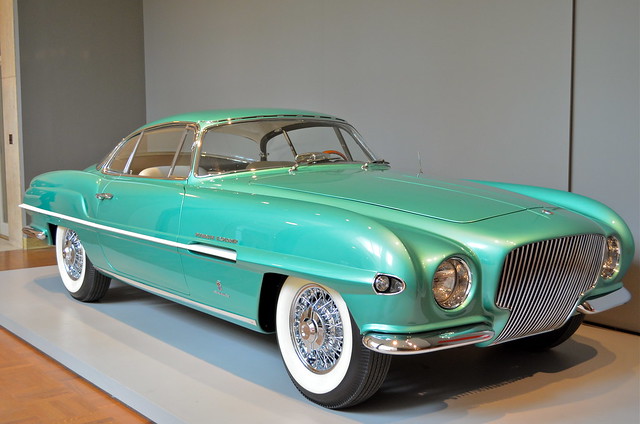
1954 Plymouth Explorer Sport Coupe, Allure of the Automobile, Portland Art Museum's Photography Day, August 14, 2011

1954 Plymouth Explorer Sports Coupe - I bought a special ticket which allowed entrance a couple of hours prior to the regular Sunday opening time. Hardly anyone present, just a few workers and a few photographers. Here is the all important agreement I signed about these particular images.

Under no circumstances may you download, upload, copy and paste any of these photos in this post. Thank you. They are not to be used for any purpose other than by me, and that purpose is to be posted on my blog, Portland Oregon Daily Photo. These are the conditions put forth by the Portland Museum of Art when I bought my Photography Day ticket. Thank you.


DSC_0076

Across the front and along the passenger side.

DSC_0309

Side view of front passenger tire, turn signal, headlight, and the grill.

DSC_0075

Grill and headlights.

DSC_0072

From the trunk forward.

DSC_0267

A second view from the trunk forward.
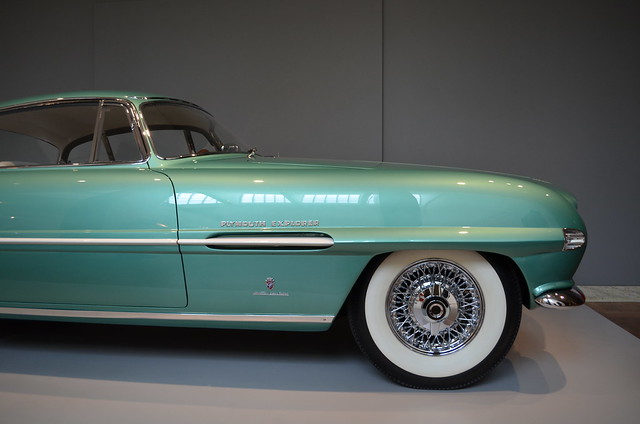
DSC_0077

Passenger door to front end.

DSC_0080

Passenger door to back end.

DSC_0079

Close-up.

DSC_0003_2

Finally, two photos with a bit different exposure, making the color look a bit different, too.
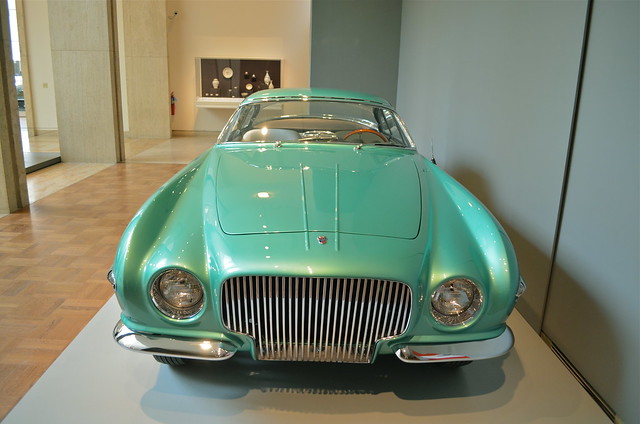
DSC_0118_2 See what I mean about the color? I think all of the earlier photos are more true in portraying the vehicle's actual color.

Info found at Concept Carz: In the post-World War II era, the public were very enthusiastic about the so-called Concept Cars of 'Dream Cars.' Virgil M. Exner had been placed as head of Chrysler's Styling department and was responsible for improving Chrysler's rather stodgy late 1940's image. He turned to Carrozzeria Ghia in Turin, Italy, to produce a unique series of one-of-a-kind 'idea cars' on production Dodge, Chrysler and Plymouth chassis. Exner had sourced the work out to these Italian craftsman because they could build these one-of-a-kind cars more creatively and less expensively than any American company.

Exner designed the Chrysler K-310 Series, which was followed by three more Ghia-built Chrysler design studies: the C-200, the SS, and the D'Elegance, as well as the DeSoto Adventurer 1 coupe. Luigi Segre of Ghia was asked to produce a memorable quartet of cars for Dodge called the Firearrows. The Dodge Firearrow III was a precursor of the subsequent De Soto Adventurer II and Plymouth Explorer concept vehicles that followed.

The sleek, wide-mouthed Explorer was mounted on a 114-inch wheelbase Plymouth chassis and was just 54-inches tall. Powering the vehicle was a 230-cubic-inch Plymouth l-head six that offered a humble 110 horsepower. There was a semi-automatic transmission, twin exhausts that exited through the rear fenders, and wire wheels. The car was distinguished by elegant ivory-hued side reveals, vestigial fins, a metal green finish, a white leather interior with bucket seats and fitted luggage.

Along with giving the public a glimpse into future designs for the company, the Dodge Firearrows, DeSoto Adventurer and Plymouth Explorer significantly helped to rejuvenate the company's image. Chrysler's 'Forward Look' styling of 1955 - 1961 inspired other automakers to return to their drawing boards to revise their models which lacked Chrysler's fresh, Italian-inspired flair. The car debuted in the May 1954 Motor Trend. Despite its racy good looks, the Explorer was powered by the 110-horsepower, 230 cubic-inch, 6-cylinder engine coupled to a Hy-Drive transmission. The dream cars were the inspiration of Virgil Exner who was hired by Chrysler boss K.T. Keller to reinvigorate the Plymouth brand. Chrysler had discovered that there was considerable interest in 'dream car' design proposals, so much so that GM took its cars on tour, staging the elaborate Motoramas around the country. Throughout the 1950s, Chrysler displayed a string of dozens of cars penned by some of the leading styling houses in Europe.

Monday, June 18, 2012

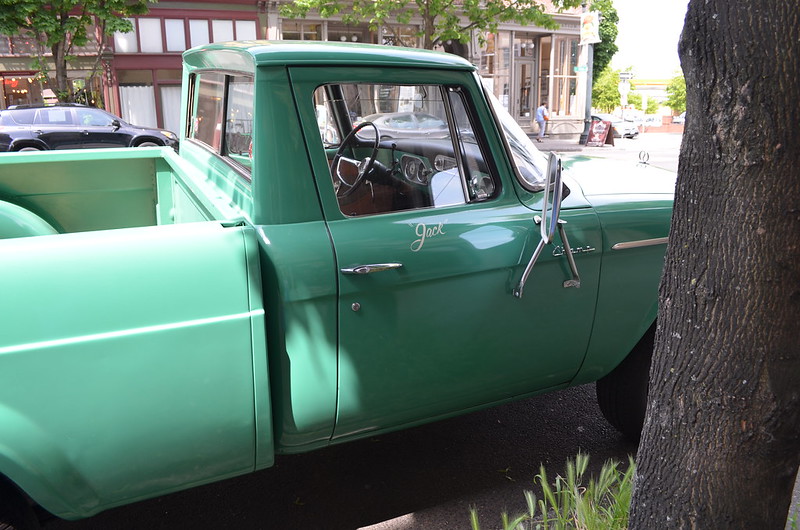
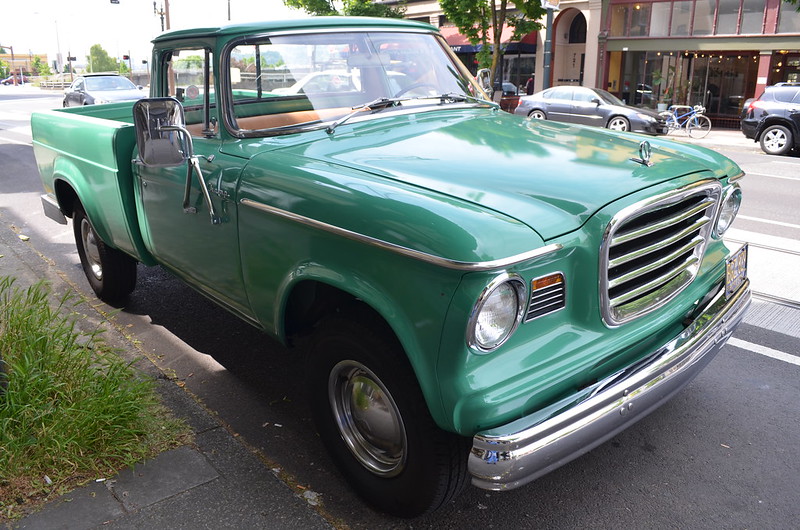
Jack, the Studebaker pickup truck

DSC_0392

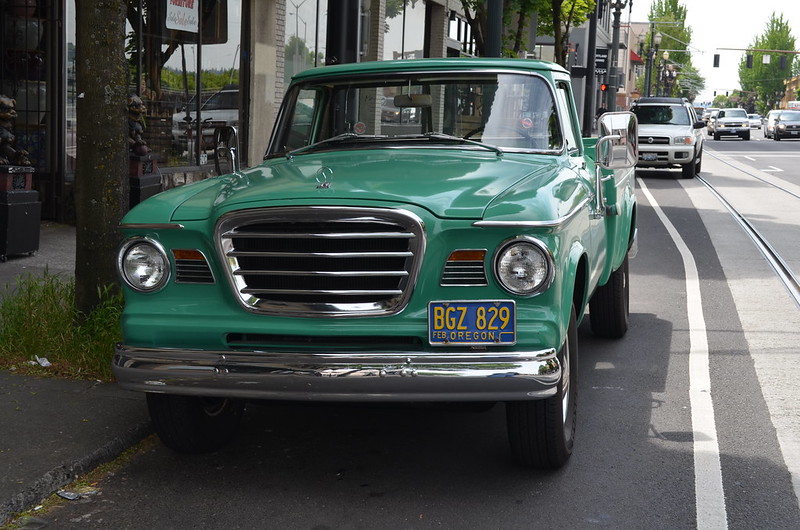
I know this pickup truck's named Jack 'cause it's painted on the passenger door just below the window. Note the sliding rear window on the cab.
  DSC_0393

See?
  DSC_0395

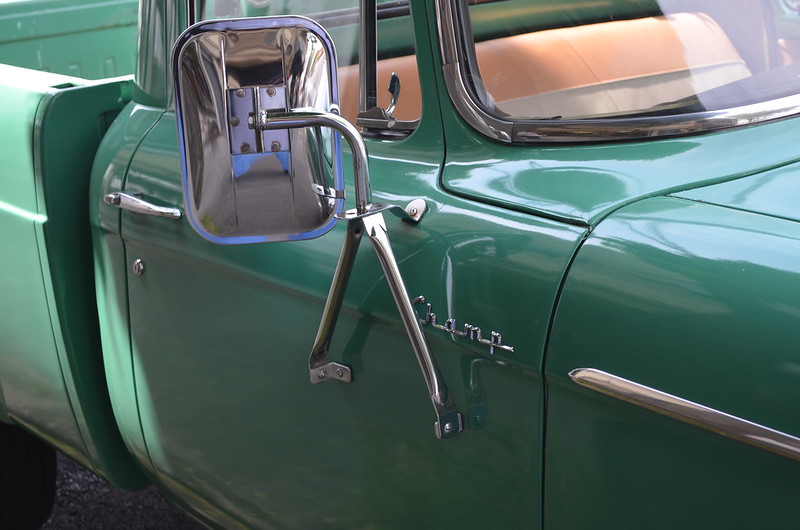
And it's a Champ. I don't know the year.
  DSC_0394

I'll say it is!
  DSC_0398

What a swell sight, all that chrome on a pickup truck! And how about that hood ornament? Stock?
  DSC_0401

Studebaker Champ, from Wikipedia:

The Studebaker Champ was a light-duty pickup truck produced by the Studebaker Corporation from 1960-1964. Designed at a time when Studebaker's truck line hadn't seen major upgrading in over 10 years, the company, which had endured years of declining sales, was forced to use a number of existing components, but the result was impressive.
The chassis and cargo box of the Champ were basically the same as what had been used for Studebaker's ½ and ¾-ton trucks since 1949, but the cab section was very different. An entirely new cab was out of the question because of cost considerations, but the new Lark compact car's body proved to be just the right size and shape to suit the purpose. The engineering staff took a four-door sedan, cut it in half behind the front doors and modified the front half slightly to fit the truck chassis. The only new sheetmetal stamping that was required was the back wall of the new cab. Minor modifications for mounting of the cab to the 1949-vintage truck frame were also made. The Lark's front end sheetmetal was retained as well, but funds were allocated to give the Champ a new horizontal-bar grille that delivered a "tougher" look.
Power Studebaker equipped the Champ with engines that had served well in the company's lineup for years. Buyers in 1960 could choose the last of the company's flathead sixes, either the Lark's 170 in³ (90 hp (67 kW)) or the time-honored 245 in³ "Big Six" (110 hp (82 kW)) which dated to the early 1930s. The 170 engine was upgraded to overhead valves (OHV) for 1961, gaining 22 hp (16 kW) in the process (up to 112 hp (84 kW)), enough of an improvement that Studebaker saw fit to finally discontinue the Big Six. The new OHV six was a novel design, retaining as many existing components as possible while modernizing an engine that had been introduced in 1939. Unfortunately, the little engine's quality came into question early on, with a number of engines developing cracks in the cylinder head. The problem, which occurred most often in engines that had improperly-adjusted valves, was never completely solved, but with proper care, the 170 remains a serviceable engine for many owners more than 40 years after it went out of production. From the start of production, those desiring V8 power could choose between Studebaker's 259- and 289 in³ engines with either a two- or four-barrel carburetor. Both engines remained largely unchanged during the Champ's production run. A wide variety of transmissions, both manual and automatic, were available in Champs. Base models came with a three-speed column shifted manual (AKA: 3 on the tree), with four- and five-speeds optional, as well as overdrive (with the three-speed). Studebaker's Flight-O-Matic (built by Borg-Warner) was the automatic option.

1960-1964 Given the cobbled-up nature of the truck, sales were fairly good for the 1960 model year "5E" series. Unfortunately, it was all downhill from there. 1961's 6E series saw the addition of a full-width cargo box, the Spaceside, for which Studebaker had purchased the tooling from Dodge. It didn't help sales, however, nor did the problems which developed early on with the redesigned six-cylinder engine. Few changes were made to the Champ in 1962 (7E series) or 1963 (8E series), and the few 1964 models built actually continued the 8E series started for the '63 models. The only new feature introduced for the 8E trucks was air conditioning. By December 1963, Studebaker's board of directors announced the closure of its South Bend, Indiana factory, and the trucks were among the casualties of the company's consolidation around an abbreviated family-car lineup in its Hamilton, Ontario, Canada assembly plant. When they purchased the rights and tooling to the Studebaker Avanti in 1964, Nate Altman and Leo Newman also acquired the rights and tooling to Studebaker's trucks. However, Altman and Newman, for reasons which are lost to history, never built as much as a single truck, and the Kaiser Jeep Corporation took over Studebaker's former Chippewa Avenue truck plant in South Bend for military production in late 1964.

A pioneering truck The Champ is seldom given credit for introducing a feature that is nearly universal among today's pickup trucks: the sliding rear window, which was available from the start, proved to be quite popular among Champ buyers. It was truly one of Studebaker's better ideas, and caught on later among the major truck makers. With a cab based on a sedan body, the Champ was among the first pickups to offer true "car-like" comfort, with a wide, comfortable bench seat and a handsomely-styled interior. Other manufacturers took until the late 1960s and early 1970s to follow the Champ's lead. Finally, the last Champs of 1963-64 were among the first American trucks — if not the first — to offer service bodies constructed of fiberglass. Today, such bodies made of fiberglass and composites are still gaining acceptance, with the steel service body remaining the mainstay. While it didn't prove to be the savior of the Studebaker truck line, the Champ also pointed the way to a more rationally-sized yet still rugged pickup, something Dodge later claimed as a "first" with their mid-sized Dakota, which was introduced as a 1987 model, nearly 27 years after the Champ.

Collector vehicles Today, the Champs that still exist are highly prized for their interesting combination of passenger-car comfort and style and their rugged mechanical durability (the sixes' head problems notwithstanding). About the only major failing of the Champ is shared with many Studebaker models: rust. Champs tend to rust most severely in the cab floor and front fenders. If left unchecked, it can be extensive and very costly to repair, if it is repairable at all.

Trivia The Champ, unlike most American pickups of the 1960s, was never offered with power steering, although such a system was offered on Studebaker's heavier-duty Studebaker Transtar and Diesels. The final "8E" (1963-64) models had an improved steering system that reduced friction and, thus, steering effort, but not to the degree that power steering would have. Of course, power steering was not yet commonplace in light trucks during the early 1960s, so Studebaker was not necessarily at a competitive disadvantage by not offering the option. From 1960 through 1964, Studebaker offered a sliding back window in the Champ pickup. This utilized the same opening as the single pane rear window, but used a double sliding channel and two panes of glass. One window could be opened until it was flush with the other. This helped with ventilation and access to the front of the cargo bed without leaving the cab of the truck.

Sunday, June 17, 2012

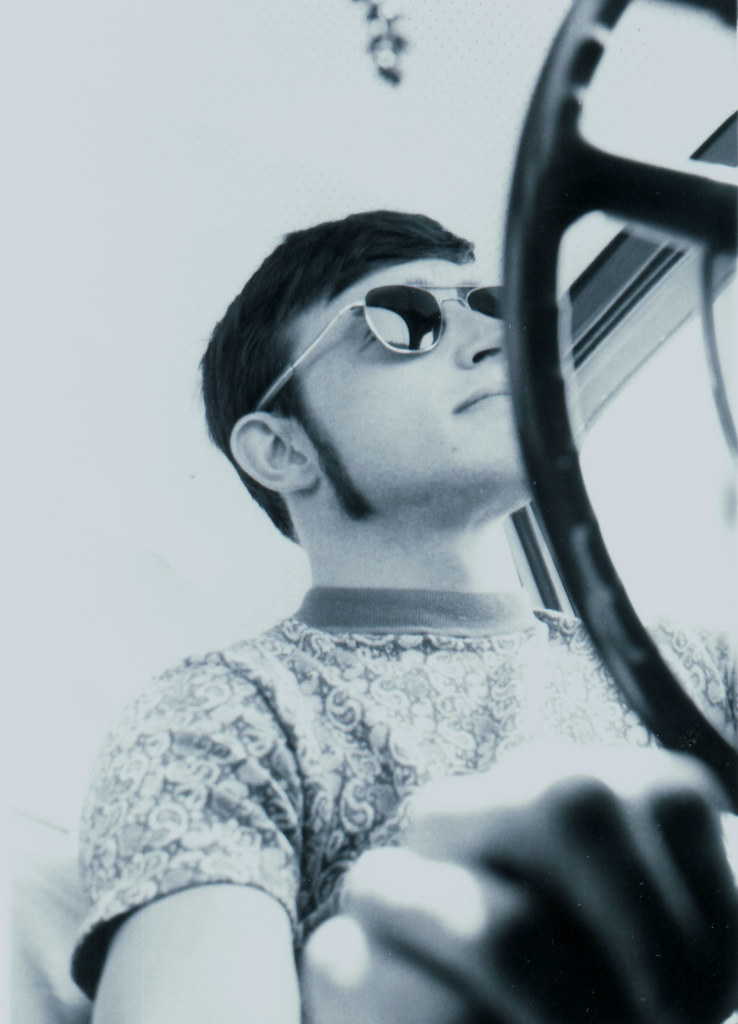
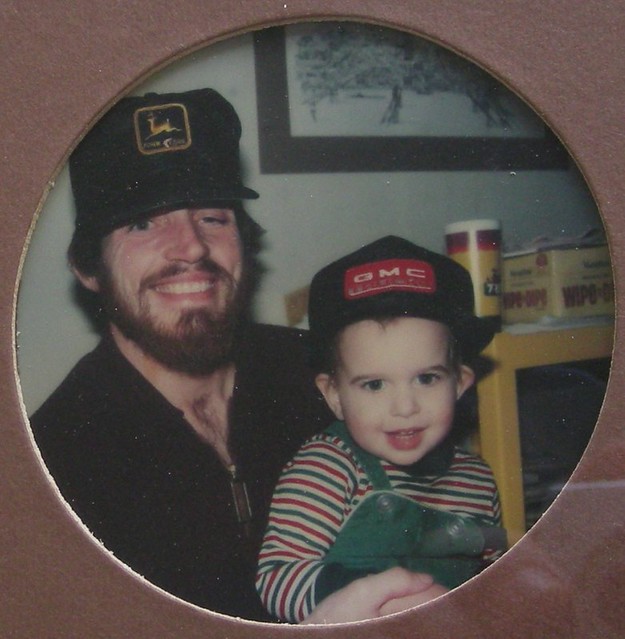
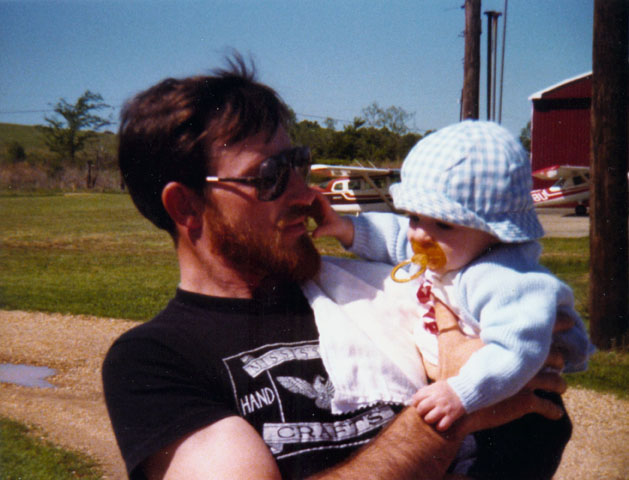
In honor of Father's Day, here's LeRoy, back in the day

TMP1

My sons' Daddy--LeRoy--driving a Volkswagen Beetle I imagine--he was partial to them. This photo was taken before I had met him on July 31, 1972, so I can't say for sure when this photo was taken or what he's driving. I can say with confidence he's certainly good-looking.

  DSCN0326p

LeRoy, still handsome, with Lamont, probably August or September, 1976.

  TMP12r

LeRoy holding Leland, probably March or April, 1979. And he's still handsome.

Saturday, June 16, 2012

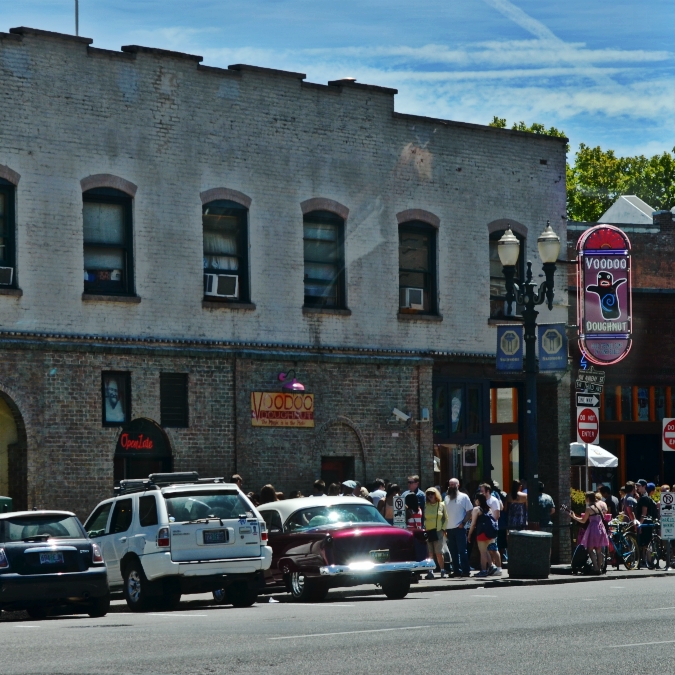
Vintage vehicle at Voodoo Doughnut & some colorful serendipity, downtown Portland

crowd_voodoo_doughnut_vintage_vehicle_BeFunky

Today on the 12 bus, on the way to Killer Burger from downtown, I noticed a crowd outside the original location of Voodoo Doughnut. The reason that I got the chance to notice the crowd and the gorgeous vintage vehicle parked at the sidewalk was that the Burnside Bridge was near the end of a bridge lift, stopping traffic in both directions.

Actually, the crowd is a double line which snakes from out of sight on the right to just left of the original Voodoo sign on the brick wall at which point it snakes back towards the corner and the red-framed door. After I saw the crowd, I saw the wine-colored vintage vehicle. The way the sun hit the back chrome bumper and the back window made me stand up and walk to the front of the bus so that I could take this photo through the windshield, looking at an angle towards SW 3rd from the intersection where the bus waited for traffic to clear once the bridge lift completely ended.

Once I had downloaded the photo, I quickly noticed the girl in the pink sundress, playing the guitar on the sidewalk directly beneath the Voodoo Doughnut sign. Ah, serendipity--all of that wine and pink color right there, together.

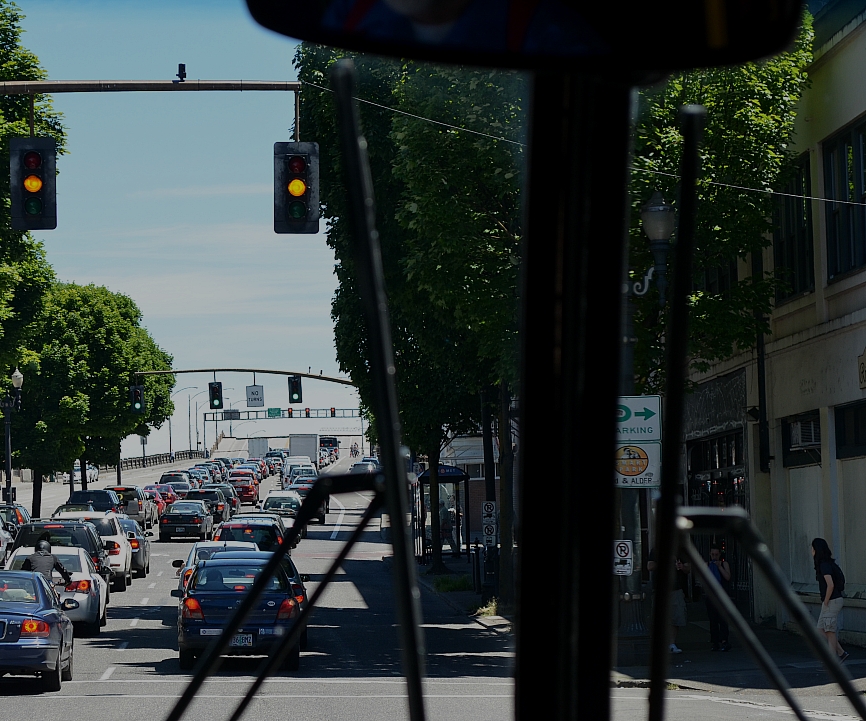
bridge_lift_burnside_BeFunky

One more photo, taken straight on through the bus windshield. Wish I could've taken one a little bit before this one because the bridge lift would've shown up much better.

As it is, if you look there at the top edge of those two box trucks, you should notice a line continuing from beneath the traffic signal on the left all the way across to the right where it runs out of sight in the leaves. That line is the edge of the western section of the Burnside Bridge which is on its way down so that it will once again meet the edge of the eastern section of the bridge and form a complete, solid surface for the bridge. I know bridge lifts interrupt traffic and therefore people's lives and work, but I continue to be fascinated by them and how these gigantic structures operate.

Info from the Voodoo Doughnut Web site, about this location:
1. Voodoo Doughnut 22 SW 3rd Avenue Portland Oregon, U.S.A.
phone 503.241.4704
OPEN 24 hours 7days a week, Cash only, ATMs available
Voodoo Doughnut is located just south of the Burnside bridge on SW 3rd Ave. On the corner at SW 3rd Ave. and SW Ankeny


Friday, June 15, 2012

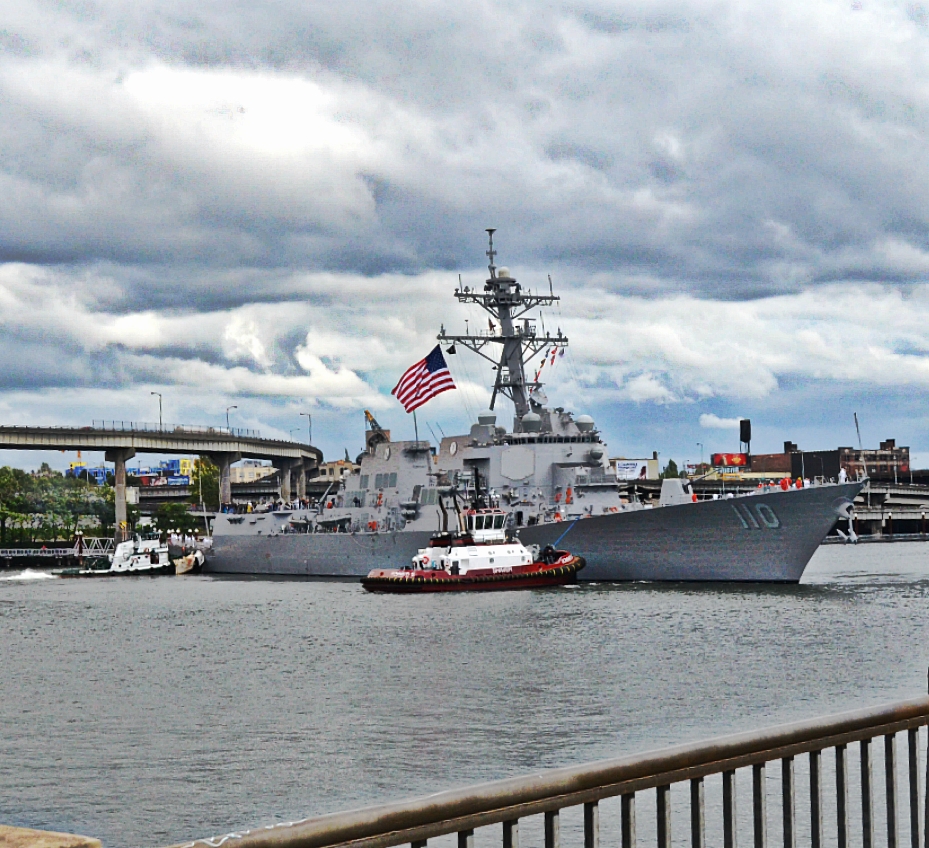
Portland Rose Festival Fleet Week, June 7, 2012, more photos No. 1

tugs_ship_1_BeFunky_HDR_1

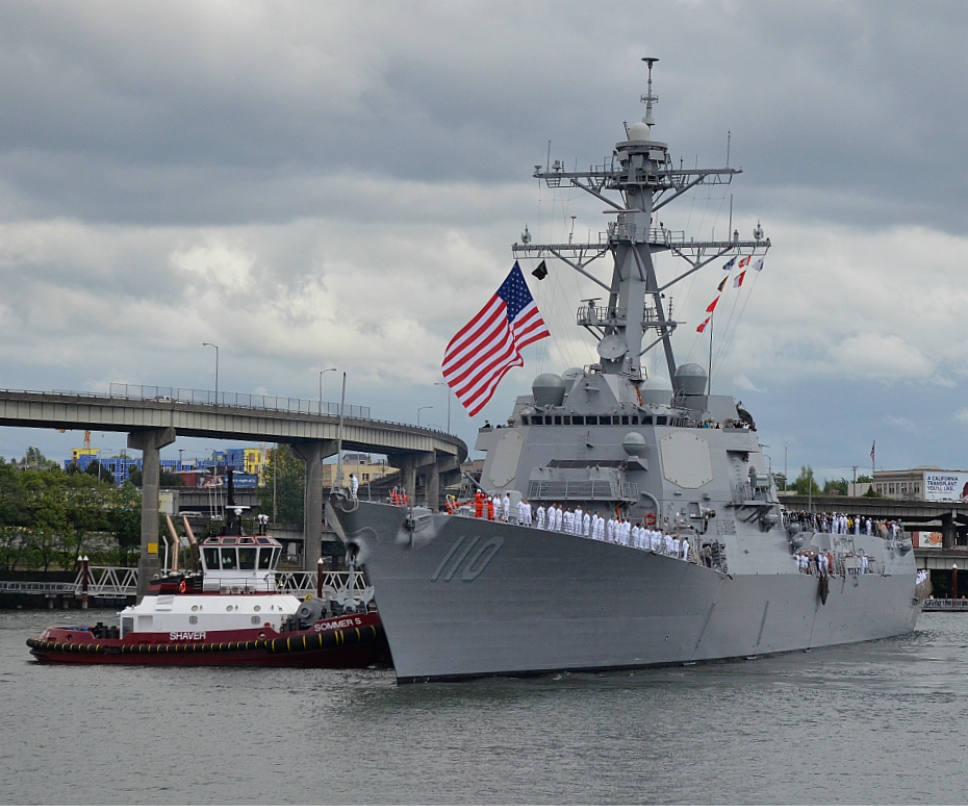
Once the USS William P. Lawrence (DDG 110) completely cleared both the Broadway Bridge and the Steel Bridge, two tugboats went to work, turning the destroyer around right in the middle of the Willamette River! The tug at the back pushed; the tug at the front pulled,using a blue strap, and in no time at all the 510 foot long ship went from pointing south to pointing west.
  tugs_ship_2_BeFunky

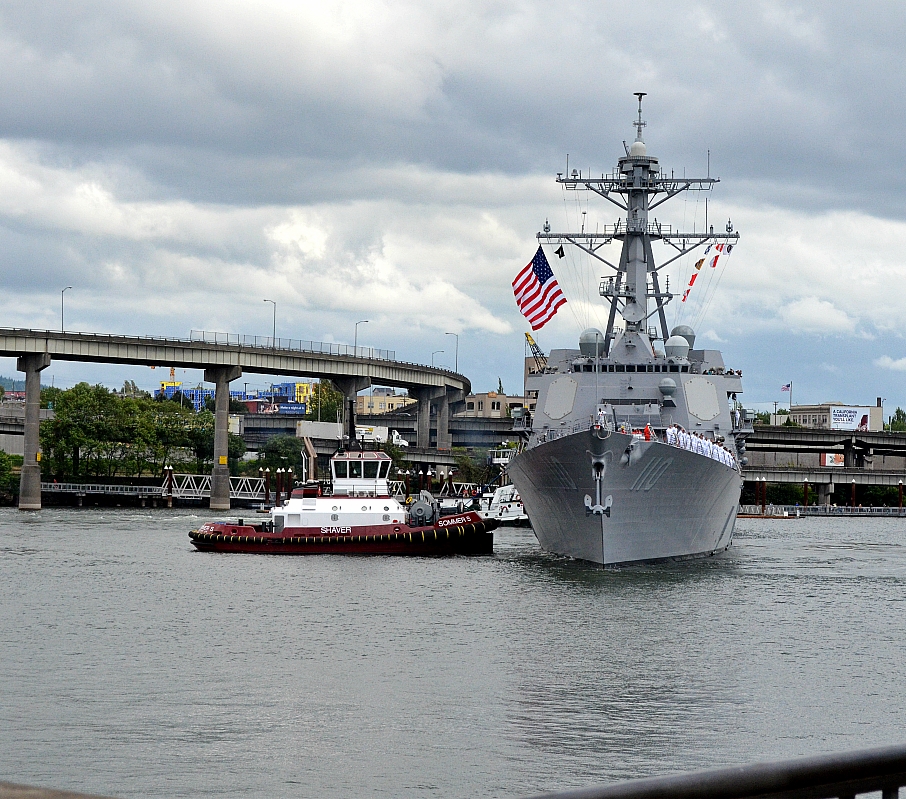
Not that the tugs stopped there. The goal, to turn the ship completely so that it pointed north, the direction that would it would go on Monday, headed to the mouth of the Willamette River where it meets the Columbia River. That's the route the ship would take back to Astoria so that it could reach the Pacific Ocean and head on home. It's totally amazing to watch, fascinating enough that time literally flies by!
  tugs_ship_3_BeFunky

I took all of these photos through the openings in a chain link fence erected along the seawall to keep the ships, except at boarding areas, separate from folks walking along in Tom McCall Waterfront Park.

Thursday, June 14, 2012

Festival of Flowers, Pioneer Courthouse Square, downtown Portland

Festival_of_Flowers_1_BeFunky_OrtonStyle_1

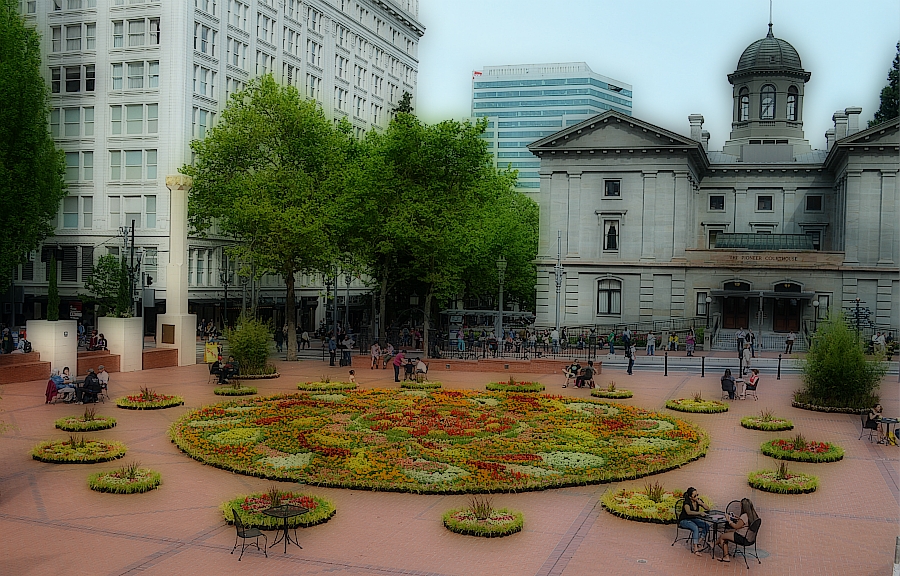
Let me set the scene. You're looking slightly north of east across Pioneer Courthouse Square, nicknamed Portland's Living Room. The white glazed terra cotta building houses Macy's and The Nines Hotel, but it was originally the Meier & Frank department store, the first major commission of my favorite Portland architect, A. E. Doyle; the building was completed in stages between 1909 and 1932. The lovely building to the right of the trees is the Pioneer Courthouse, completed in 1875. And in front of it is a TriMet MAX Yellow and Green line light rail station--those people milling about are waiting for a ride closer to home.

At BeFunky dot com, I've altered this photo by cropping it, sharpening it, and using the special effect Orton. The result reminds me how some vintage post cards look--I really like it.

About the flowers, here's the news release from The Square PDX dot org:
FESTIVAL OF FLOWERS CONTAINER OF ESSENCE ARRIVES TO PORTLAND’S LIVING ROOM JUNE 1ST! PORTLAND, OR – (May 25, 2012)

The 28th Annual Festival of Flowers celebration officially opens June 1st in the heart of Downtown Portland!

This year’s design, Container of Essence created by local artist and sculptor Dana Lynn Louis, will be on display at Pioneer Courthouse Square through June 12th.

Container of Essence at the Square will bring together nearly 20,000 colorful flowers, bamboo and ornamental grasses to create a mandala in the heart of downtown encouraging peace within one’s self and the world at large. In conjunction with the two week festival there will be plenty of noon time activities encouraging downtown visitors to find their inner peace with free yoga and meditation! For two weeks on Mondays, Wednesdays, and Fridays, grab your yoga mat as the Square transforms into an outdoor yoga studio. Beginning June 4th at 12pm, CorePower Yoga instructors will be conducting FREE Yoga classes on the Square. For more moments of Zen, Maitripa College, one the first Buddhist colleges in America will be leading classes in meditation on June 5th and 12th. KIND Healthy Snacks will also be at the Square for “KIND Tuesday” on June 5th as they hand out free snack bars and seed packets for your garden, while supplies last.

Festival_of_Flowers_2_BeFunky_cropped_fill_light_sharpened


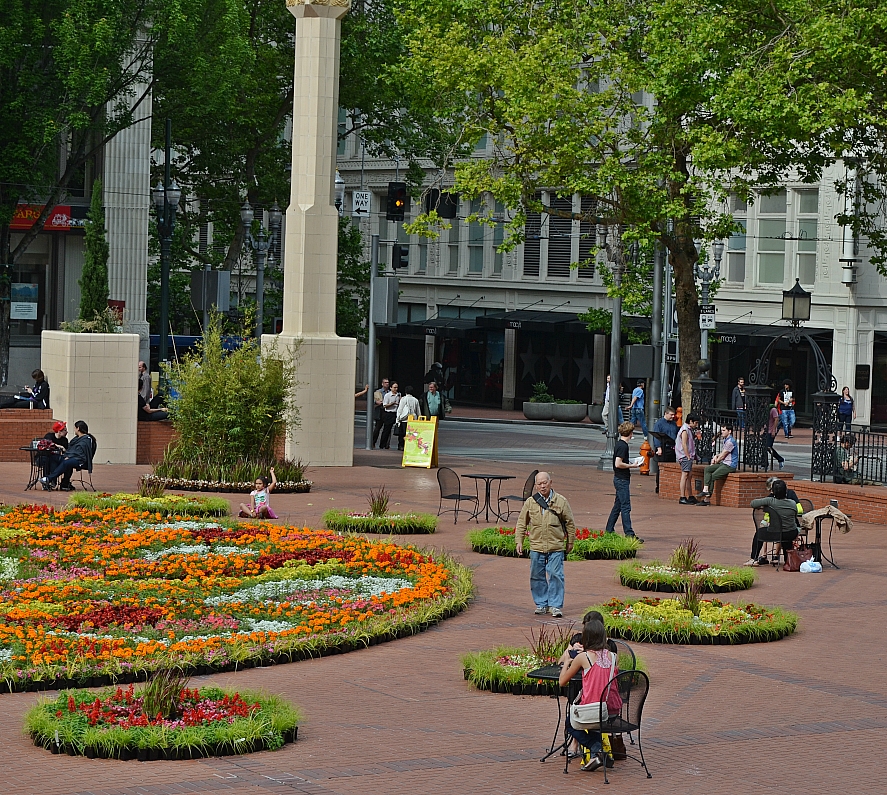
See the little girl sitting on the bricks, near the mandala, with her left arm raised in the air? Would that I could read  her mind and know the memories she's making at the sight of these lovely flower designs.


And this info about the Flower Sale, from the same Internet source:

2012 Festival of Flowers Price List

Container of Essence Design by Dana Lynn Louis
4” Flowers/Annuals & Herbs
$1/each or $10/Dozen

Flowers/ Annuals ($1 each)
Blue Salvia, Red Salvia, Red Begonias (bronze leaf), Red Begonias (green leaf), Durango Red Marigolds, Orange Marigolds, Orange Impatiens Extreme, White Alyssum, White Impatiens Extreme, White Begonias (green leaf), White Begonias (bronze leaf), Light Pink Impatiens Extreme, Light Pink Begonia (green leaf), Coral Petunias Simply Madness, Dark Pink Impatiens Extreme Rose, Dark Pink Begonias (green leaf), Lime Green Coleus Versus

Herbs ($1 each)
Peppermint, Spearmint, Lemon Balm, Common Sage, Hyssop, Chives

3.5” Grasses/ Perennials ($3 each)
Acorus Gramineus ‘Ogon’, Carex Dolichostachya ‘Kaga-Nishiki’, Juncus Effusus ‘Unicorn’

1 gallon Grass ($5 each) Imperata Bloodgrass

Bamboo ($60 each) 8-10ft Phyllostachys nigra from Bamboo Garden

Flower Sale begins Wednesday June 13th at 8:00AM
Boxes and Bags available while supplies last!

Wednesday, June 13, 2012

Portland Rose Festival Fleet Week, June 7, 2012

Both of these photos have been altered at PicMonkey with the HDR special effect.
  Fleet_Week_PFB_fire_boat_Broadway_Bridge

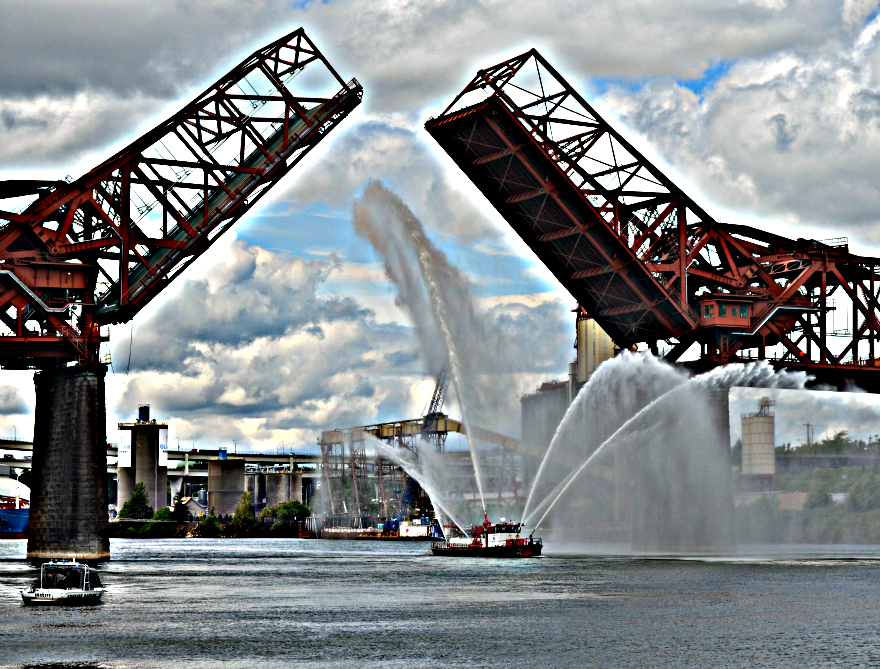
As much as I love parades, my favorite event connected with the Portland Rose Festival is the arrival of the fleet. I took this photo of the Portland Fire Bureau's fireboat as it passed under the Broadway Bridge which is in full open position during a bridge lift. The bridge lift means that not too far north of the fireboat there must be a United States Navy vessel on its way to dock at the west seawall, right in downtown Portland.

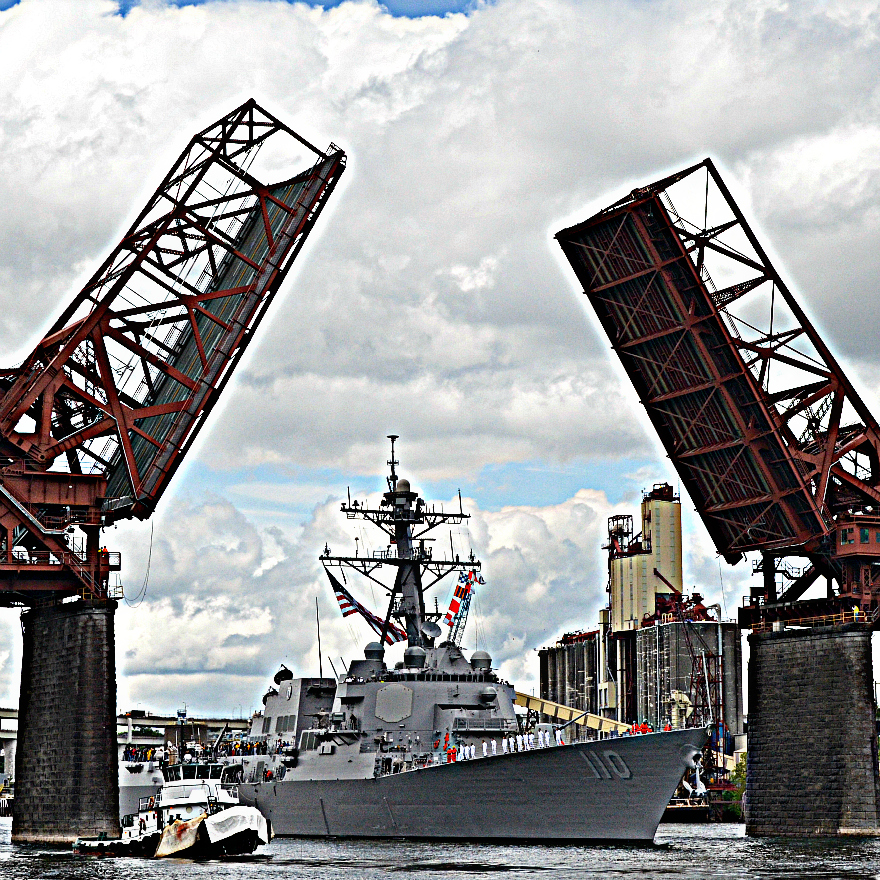
Fleet_Week_USS_Lawrence Turned out that the guided-missle destroyer USS William P. Lawrence (DDG 110) was the first to arrive.

The destroyer's dimensions: length, 510 feet; beam, 66 feet; and draught, 31 feet. It's surface speed can reach 37 mph. The engines are 4 x General Electric LM2500-30 gasoline turbines developing 100,000 shaft horsepower to 2 x shafts.

Here are two interesting articles about the destroyer which I found on the Internet at Navy dot mil. 

Navy Welcomes William P. Lawrence To The Fleet Story Number: NNS110604-08Release Date: 6/4/2011 9:23:00 PM A A A By Mass Communication Specialist First Class Brian S. Finney MOBILE, Ala. (NNS) --

The Navy welcomed guided-missile destroyer USS William P. Lawrence (DDG 110) into the fleet during a commissioning ceremony in Mobile, Ala., June 4.

The newest Arleigh Burke-class ship, the 60th of its class, is named in honor of the late Vice Adm. William P. Lawrence, a highly-decorated Naval aviator and Vietname prisoner of war.

Lawrence began his naval career as an academic scholar and athlete at the U.S. Naval Academy, where he later returned to occupy the Chair of Naval Leadership after retiring from active duty, Feb. 1, 1986.

His aircraft was shot down over North Vietnam in June 1967 and he was held captive until March 1973. His dedication and perseverance during that period inspired the ship to claim the motto, "Never Give In."

"[Lawrence] and many others were heroes among heroes by leading a resistance of our prisoners in Vietnam," said Adm. James Winnefeld, commander, North American Aerospace Defense Command and Commander, United States Northern Command. "Indeed we should recognize those men that are with us today because consistent with our ship's motto, they never gave in."

"I assure you we will be ready," said Cmdr. Tom Williams, commanding officer, USS William P. Lawrence (DDG 110). "Whatever challenge may be ahead for this crew, we have set a good course and the only course I will accept is toward excellence."

An audience of more than 3,000 attended the ceremony, held at the Alabama State Docks. The crowd consisted of family and friends of USS William P. Lawrence crew members, a host of U.S. military veterans and many others associated with the Lawrence family.

The ship was christened by three women important to Lawrence, his widow, Diane Wilcox Lawrence, and daughters, Dr. Laurie Macpherson Lawrence and U.S. Navy Capt. (ret.) Wendy B. Lawrence, the ship's sponsor.

The ceremony concluded when the Lawrence family said, bring our ship to life!" The Sailors then manned the rails.

"I look at this as a spring board to much greater things, it's my first command and I couldn't be happier," said Sonar Technician Seaman Apprentice Scott Peterson. "I am very proud to be a part of the most technologically advanced warship in the world."

During the ship's brief stop in Mobile, the crew of William P. Lawrence was heartily welcomed by the local community. The city's minor league baseball team hosted a Navy night, during which Williams threw the first pitch. Crew members also donated many service hours to Habitat for Humanities community relations projects.

"The Sailors on this ship has taken [Lawrence's] spirit and his character to heart and they're the real secret to making this the best ship in the fleet, said Williams. "We're named for a modern naval hero who was known as the Sailor's Admiral, and he really took care of people."

And here's one more: Navy's Newest Destroyer To Arrive In San Diego Story Number: NNS110628-16Release Date: 6/28/2011 9:31:00 PM A A A From Naval Surface Forces, U.S. Pacific Fleet Public Affairs SAN DIEGO (NNS) --

Sailors on the Navy's newest destroyer are scheduled to arrive with their ship at Naval Base San Diego, July 1.

The guided-missile destroyer USS William P. Lawrence (DDG 110), the 60th Arleigh Burke class destroyer, was built in Pascagoula, Miss. and commissioned during a ceremony at the Alabama State Docks in Mobile, Ala. June 4.

After commissioning, the ship departed Mobile and sailed through the Gulf of Mexico, Caribbean Sea and Panama Canal into the Pacific Ocean on its voyage to its homeport of San Diego.

Cmdr. Thomas R. Williams II is the first commanding officer of the 9,200-ton warship's 280-person crew.

"It is wonderful to celebrate our homecoming on the 4th of July weekend with our families," said Williams. "Our goal as a command for the past year was to make it home by the 4th, and I'm very proud of the Lawrence warriors who worked so hard to make it possible."

The new destroyer honors the late Vice Adm. William P. Lawrence, an accomplished leader and the first naval aviator to fly twice the speed of sound. During the Vietnam War, as commanding officer of Fighter Squadron 143, Lawrence was awarded the Silver Star for a strike against a heavily defended target in North Vietnam. He completed his mission, but was captured after his aircraft went down in June 1967 and remained a prisoner of war (POW) until March 1973. He was awarded the Distinguished Service Medal for his leadership to fellow POWs.

While a POW, Vice Adm. Lawrence composed a poem entitled "Oh Tennessee, My Tennessee," which was subsequently designated as the official poem of the State of Tennessee by the state legislature.

The ship is capable of carrying Tomahawk missiles, anti-submarine torpedoes, surface-to-air missiles, as well as a five-inch gun and two SH-60 helicopters.

William P. Lawrence helps provide deterrence, promote peace and security, preserve freedom of the sea and humanitarian/disaster response within 3rd Fleet's 50-million square mile area of responsibility in the Eastern Pacific, as well as supporting the Navy's Maritime Strategy when forward deployed.

Tuesday, June 12, 2012

Rose Festival Fred Meyer Junior Parade on June 6, 2012

Jr_Parade_Prov_Child_Center_BeFunky

Nicknamed by some "the children's parade," last week's event drew a crowd of 40,000-50,000 along its route in the Hollywood District, Northeast Portland. The Rock 'n' Roses refers to the theme for this year's Portland Rose Festival. I took a day of vacation so that I could go for the first time. After lunch at Killer Burger at the corner of NE Sandy Blvd. and NE 47th, I took my lawn chair outside, found a space on the sidewalk at the curb, and settled down to enjoy myself.

I expected to see lots of bands and scout groups, but I didn't expect to see maybe 40 children of all ages being pushed along in their wheel chairs by people who might be parents or who work or volunteer at the Providence Child Center.

Here are two photos of just a handful of the children and those who care enough to provide them with a chance to be in a parade. How neat!
  Jr_Parade_Prov_Child_Center_2_BeFunky

I found this online about Providence Child Center which is Part of Providence Health and Services:

Providence Child Center (PCC) has been caring for Oregon’s most vulnerable children for over 60 years. Today it continues to fill an important gap in the community not provided by any other organization regionally. We are rooted in the commitment to promote the inherent dignity of all children by providing each child in our care the opportunity to achieve his or her potential and the highest quality of life in an atmosphere of acceptance and love.

And this explains all about a concept new to me, but when you think about it, it makes perfect sense.
Pediatric recreational therapy

Also known as: Recreational therapy, pediatric; Therapeutic recreation, pediatric

Recreational therapists provide recreational activities and treatment for patients with disabilities or illnesses. Therapeutic activities can include arts and crafts, animals, sports, games, dance and movement, drama, music or community outings. Recreational therapists improve and maintain the physical, mental and emotional well-being of their clients.

The therapeutic recreation team at Providence Child Center provides recreational opportunities for our kids that enhance their health, functional abilities, independence and quality of life. Our therapy staff is supported by hundreds of volunteers who make it possible to provide unique and exciting recreational activities.

The following are highlights of a few of these programs:

  • Crafts, music and sports groups are continuously provided by our creative staff, volunteers, and community partners. 
  • Community integration field trips to Portland Trail Blazer Games, OMSI, the Saturday Market, the movies and more. 
  • The Friend to Friend program partners local students with our kids for a year’s worth of friendship and life-long memories. 
  • Holiday parties, like the annual Christmas Present Celebration, a Valentine’s Day Dance, the New Year’s Eve party, and the Chinese New Year’s parade. “Foster” Grandparents who help with everything from getting our kids on the Portland Public School buses every morning to tucking them into bed at night. 
  • Special events and typical child-hood traditions including the Jr. Rose Parade, a traditional Prom, birthday parties and summer camp. 
  • Alternative therapy services like music therapy and pet therapy– we’ve hosted everything from harps to lamas! 
It is our goal and privilege to provide therapeutic recreational activities that celebrate ability while ensuring every child in our care has access to typical childhood experiences. 

Monday, June 11, 2012

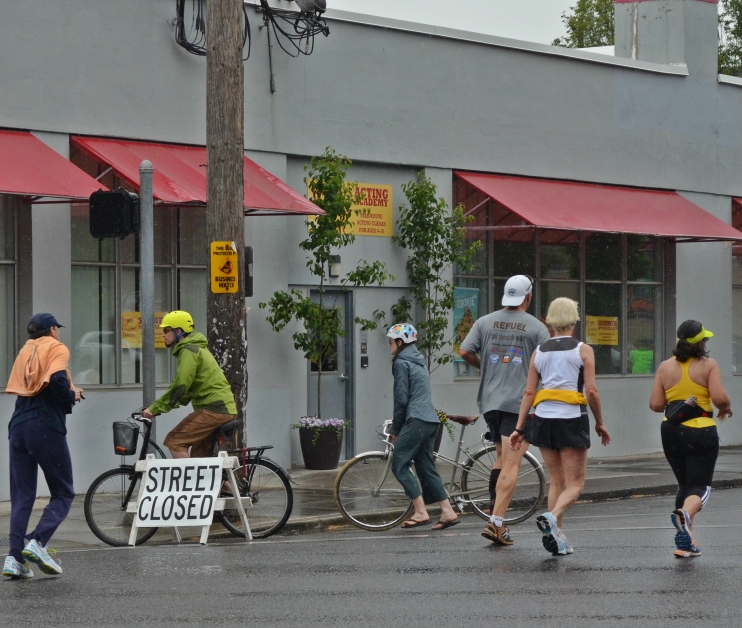
The other few moments that I witnessed during the Rock 'n' Roll Half Marathon on May 20, 2012, at the intersection of NE Sandy Blvd. and NE 20th Avenue, right in my neighborhood!

rocknrollhalf_wait_to_cross_sandy_1_BeFunky_HDR_1

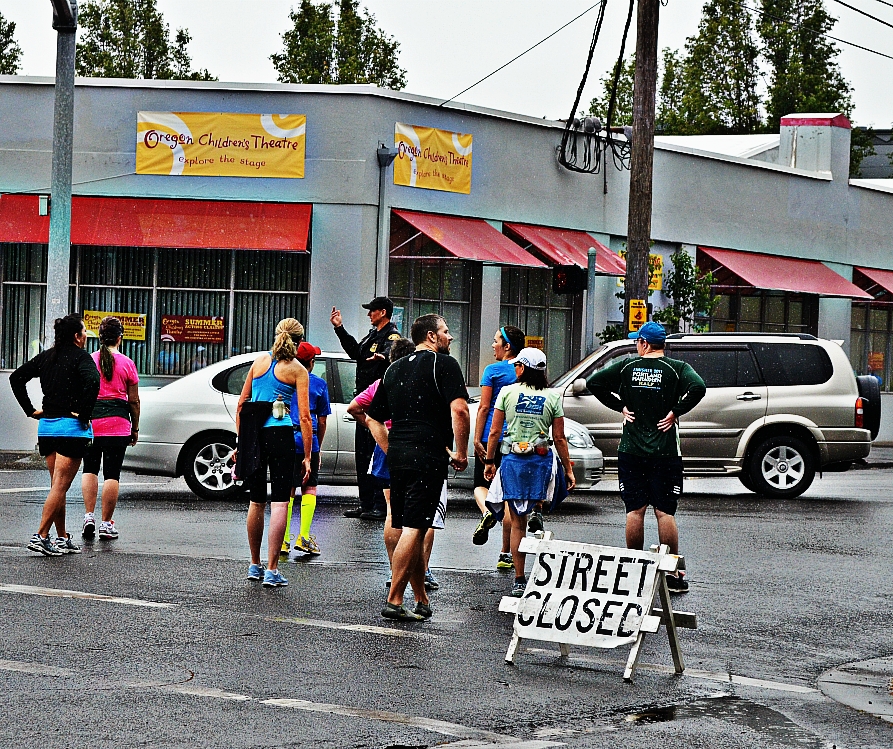
The sign boldly states "Street Closed." Well, until the Portland Police Bureau officer (and a nearby, out of the photo TriMet employee) decided that the time had come to let the traffic stopped on NE Sandy flow east and west. Thus, the runners came to a stop, waiting silently, speckled with falling rain. I heard only the sound of tires traversing the wet pavement.
  rocknrollhalf_wait_to_cross_Sandy_BeFunky_HDR_1

This intersection must have been just one of many on the route at which runners had to stop for a short time while law enforcement officers cleared the stopped traffic. NE Sandy Blvd. is one of the major thoroughfares in northeast Portland, used by two busy bus lines, even on a Sunday. Since it was cool and rainy, I wondered whether or not the runners welcomed the short pauses. I have to imagine that, for the most part, they didn't.
  rocknrollhalf_bus_about_gone_BeFunky_HDR_1

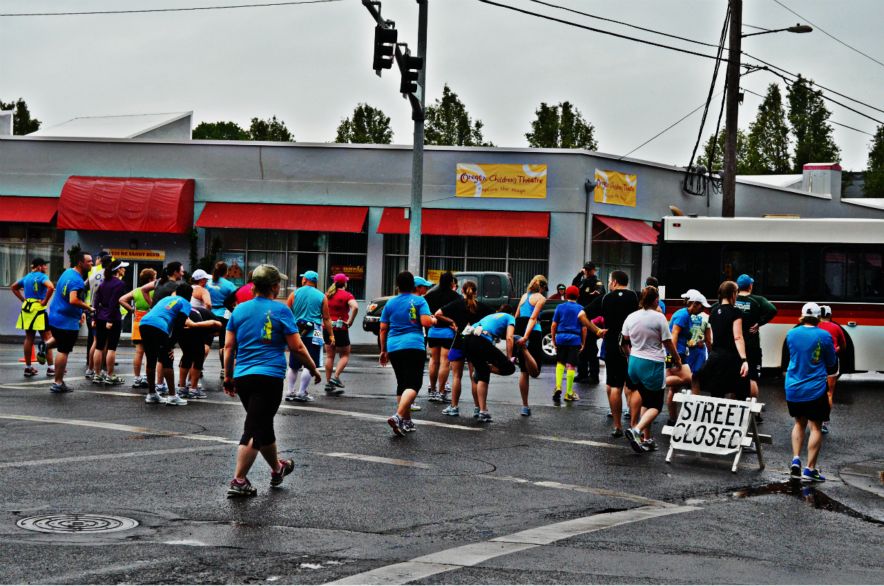
The intersection is almost cleared now. Runners, ready!
   rocknrollhalf_bus_gone_BeFunky_HDR_1

There they go, on their way mid-way from mile 10 to mile 11 and beyond!

Sunday, June 10, 2012

The first of a few moments that I witnessed during the Rock 'n' Roll Half Marathon on May 20, 2012, at the intersection of NE Sandy Blvd. and NE 20th Avenue, right in my neighborhood!

rocknrollhalf_2_thread_needle_BeFunky

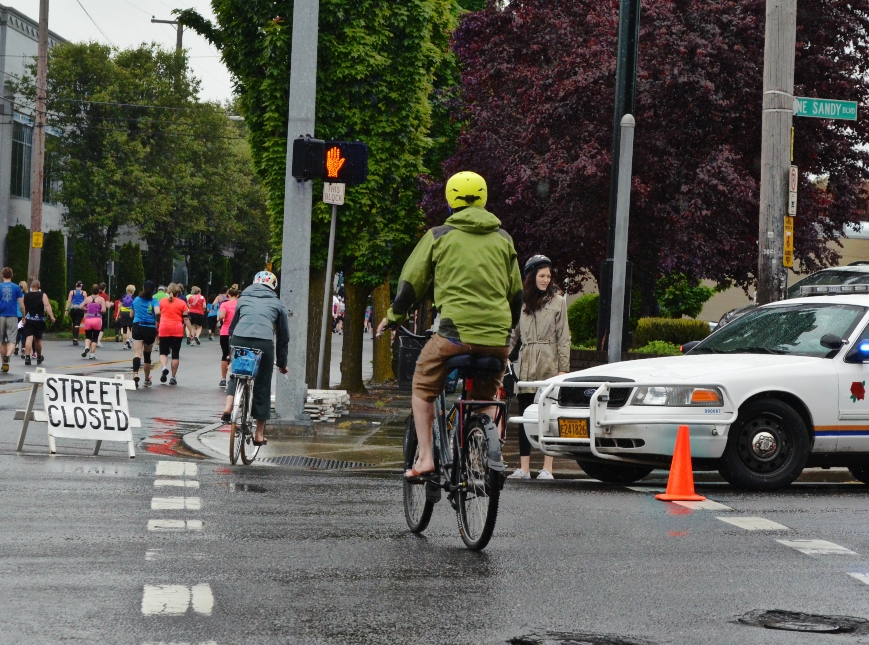
A woman on a bicycle cautiously approached NE Sandy, heading north on NE 20th Avenue. Since there's a police officer stopping traffic from the center of the intersection so that runners in the Rock 'n' Roll Half Marathon can continue on their way, she crosses the street. I like how the red hand on the traffic signal looks as if it is attached to her bicycle helmet like the comb on a rooster!
  rocknrollhalf_3_thread_needle_BeFunky

Here comes the next bicyclist crossing Sandy behind her. I have to say that I am shocked somewhat to see that the two of them are bicycling the city streets in flip flops. Thank goodness they're wearing helmets. I'll bet they're together--the flip flops give them away.

  rocknrollhalf_4_thread_needle_BeFunky

The two of them wait patiently on the corner, searching for a break in the runners. You can tell how much rain the man's been riding in when you take a look at the discolored front of his shorts; her pants are wet, too, but the difference in color is not easy to discern unless you click on the huge original size of the photo which I cannot put here on the blog--sorry. On that original size, it's easy to see drops of rain here and there, too.

rocknrollhalf_5_thread_needle_BeFunky

Just about made it, threading the needle all the way across NE 20th, heading west.
  rocknrollhalf_6_thread_needle_2_BeFunky

Yep, home free now. What cracks me up is that when I looked at this photo as I cropped it, I wondered what in the world is that woman doing with the toes of her left foot? The dark spot caught my eye, and I had to see for myself, so I clicked on the huge original size of the photo to take a look. She's got those two outer toes crooked upward like she's trying to keep them from hanging off the edge of her flip flop as she trots along beside her bicycle. How many of us do something similar, unconsciously? I used to do that back when I wore flip flops.

Saturday, June 9, 2012

Artsy fun with Monet's Blue irises which I saw on Memorial Day at Schreiner's Iris Gardens, Salem, Oregon

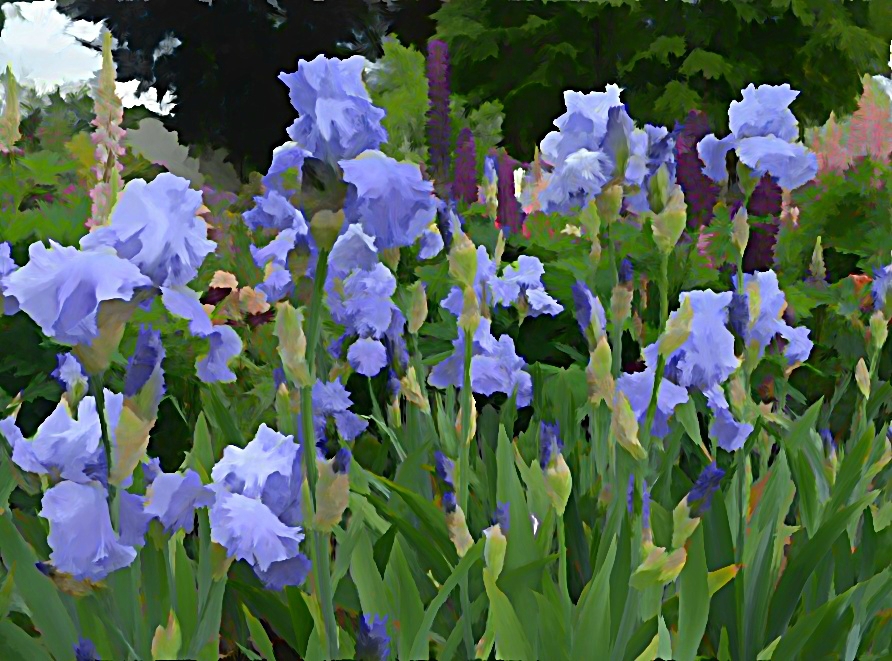
Monets_blue_2_BeFunky_Underpainting_1

One version of the Be Funky artsy effect, underpainting.
  Monets_blue_1_BeFunky_Underpainting_2

Another version of the Be Funky artsy effect, underpainting.
  Monets_blue_cropped_2_BeFunky

The actual beautiful irises.
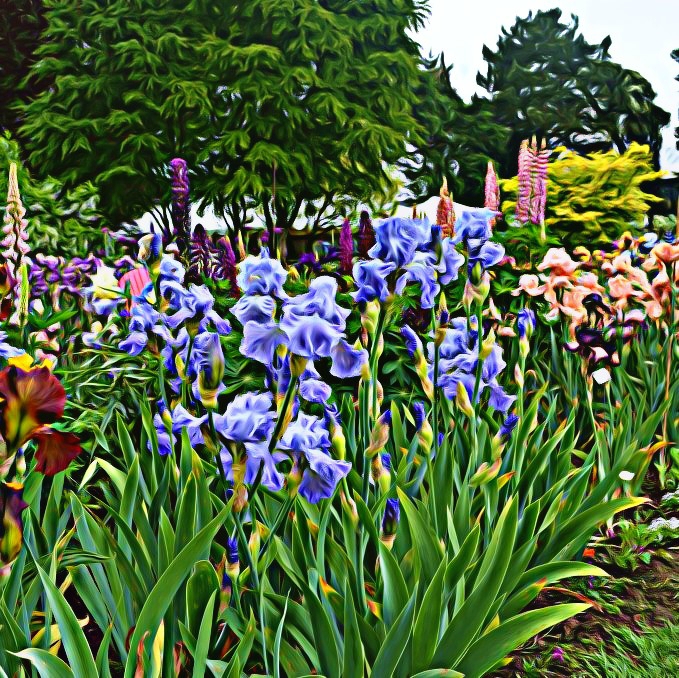
  Monets_blue_BeFunky_underpainting

A different view of Monet's Blue irises, as altered by Be Funky's artsy effect underpainting.
  Monets_blue_cropped_BeFunky

The actual beautiful irises. About Monet's Blue from the Schreiner's online catalog. It is a tall bearded, light blue iris originated by Schreiner in 1998. The description. Boldly ruffled petals finished in soft heavenly blue elicit the same shimmering feeling conveyed in the works of Claude Monet. Each flower is saturated in this lovely blue color, as close to "true" blue as an iris comes. Its tall stems consistently produce three branches and a spur with 7-8 buds. Growth habit is vigorous.

Friday, June 8, 2012

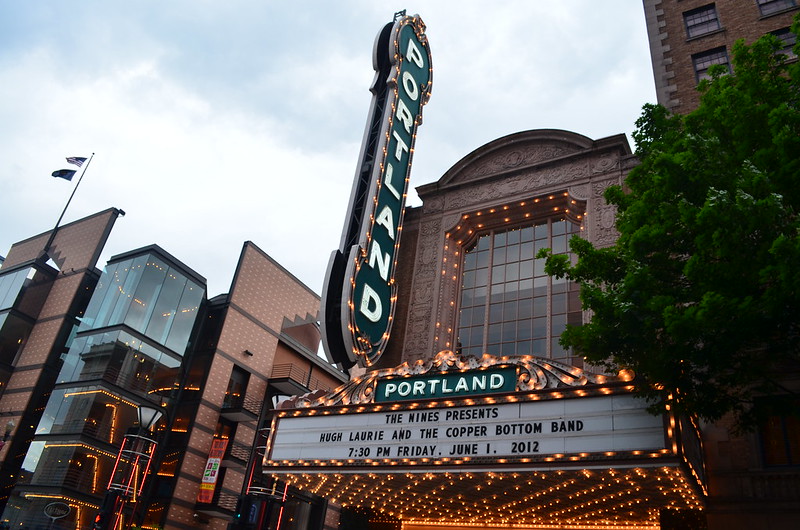
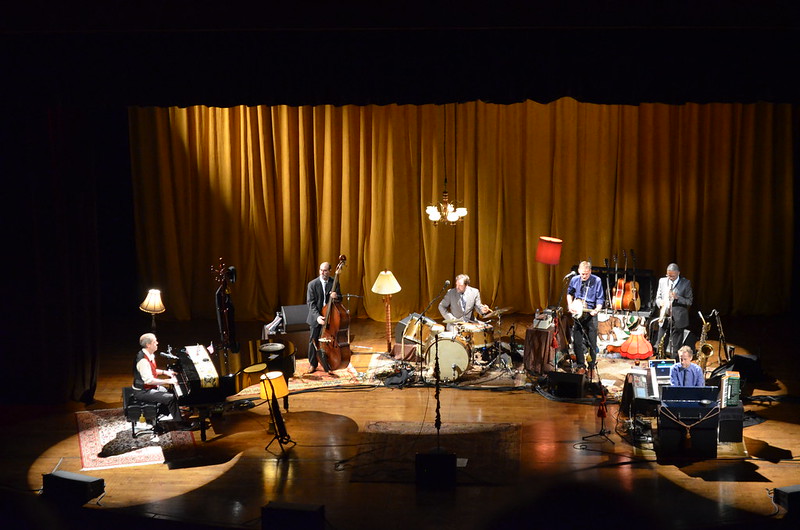
Hugh Laurie and the Copper Bottom Band, June 1, 2012, at the Arlene Schnitzer Concert Hall, downtown Portland

DSC_0330

The marquee connected to the iconic Portland sign says it all. Here's what Laurie's Web site had to say about the tour:

Hugh Laurie will take the music from his critically acclaimed debut album Let Them Talk on the road for a run of select dates on the West Coast. The 10-show tour will kick off on May 22 in San Diego and include stops in Los Angeles, San Francisco, and Portland before concluding on June 4 in Seattle. 

This marks Laurie’s first U.S. tour, following up on two heralded performances last year at The Mint in Los Angeles and the Hardly Strictly Bluegrass Festival in San Francisco.

Laurie will be on vocals and piano and will be joined onstage by The Copper Bottom Band, featuring a cast of renowned musicians including Jay Bellerose (drums), Kevin Breit (guitars), Vincent Henry (horns), David Piltch (bass), and Patrick Warren (keyboard/accordion).
  DSC_0333

Laurie alternated from playing the piano and singing from there, just playing the piano, or just singing at the mic at center stage. The music performed ranged from "Unchain My Heart" to "St. James Infirmary" to "You Don't Know My Mind" to "Suwannee River" to "Tipitina." Made me wish for younger knees and feet and the opportunity to stand up and dance the night away. The man played and/or sang for a couple of hours without a break, then took a bow and came back to do, I think it was, two more songs for an encore. As far as I'm concerned, Laurie was a great big piece of cake which certainly makes the Copper Bottom Band the perfect icing on said piece of cake.
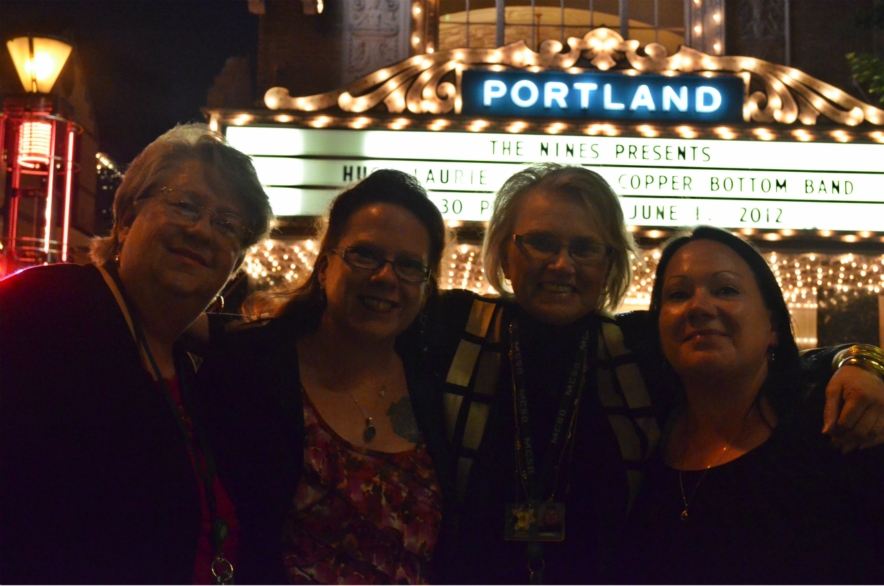
  Me_Sharon_Twins_BeFunky

After the show, someone offered to take our photo--that's Sharon in the middle of her twin daughters and me on the left. Smiles all around after a most satisfying evening of entertainment and live music.

Thursday, June 7, 2012

An Evening with The Schonz

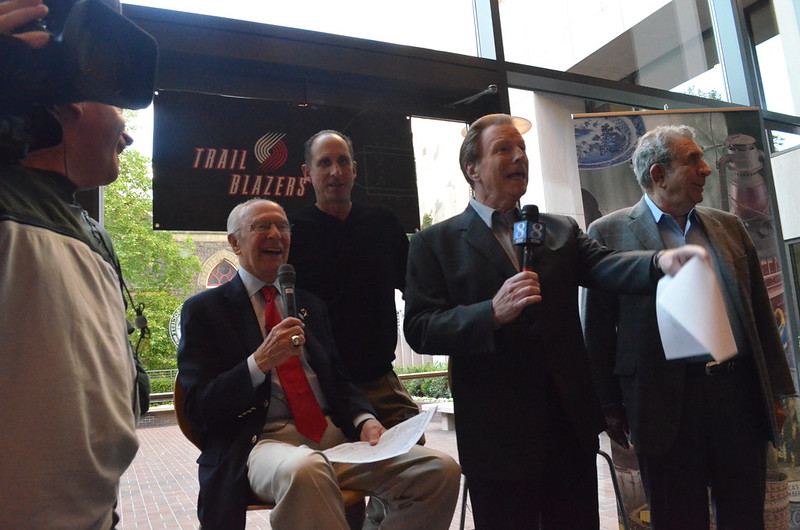
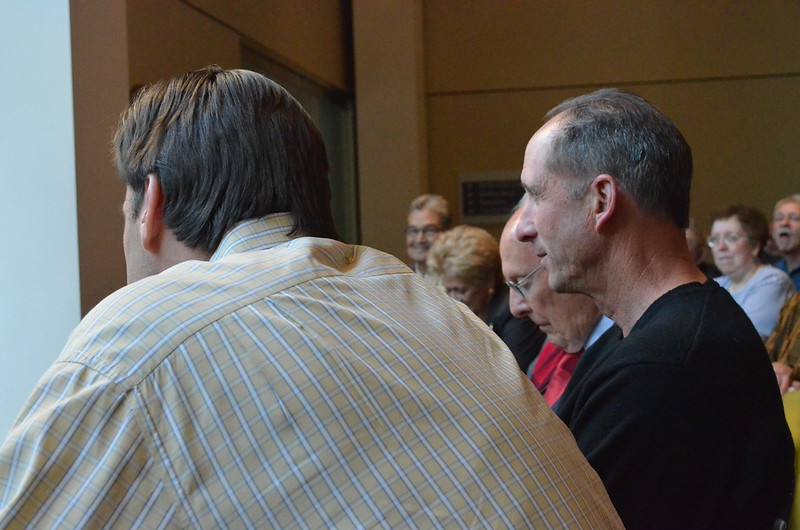
Tuesday, June 5, after work I ate a quick burger and fries at McDonald's downtown, then headed on over to the Oregon Historical Society for a prime-time event. An Evening with The Schonz: As any true Oregonian knows, on June 5, 1977, the Portland Trailblazers won their first and only NBA Championship. On the 35th anniversary of that championship, Blazer broadcasting legend Bill Schonely--aka "The Schonz"--will share his memories of that championship year, and of a remarkable broadcasting career that earned him a place in the Basketball Hall of Fame.
  DSC_0372

Before the evening began, I took this photo. There in the distance, you see Dale Schlueter, 6'10" center on the team 1970-1972, the first two years of the team's existence; Mrs. Harry Glickman, wife of one of the founders of the team; Bill Schonely, first play-by-play announcer for the team and still with the team 42 years later; Bobby Gross, a 6'6" starting small forward for the team during the championship season; and around to the back of Chris Dudley, a 6'11" center who was a Trail Blazer from 1993-1997.
  DSC_0379

During the evening we went "live" to the local NBC affiliate, KGW, for a couple of spots on their week-nightly show, Live at 7. Here the reporter Joe gets everyone involved--that's him with the sheet of paper in his hand. Left to right, KGW cameraman, Mr. Schonely, Bobby Gross, Joe, Mr. Harry Glickman.
  DSC_0385

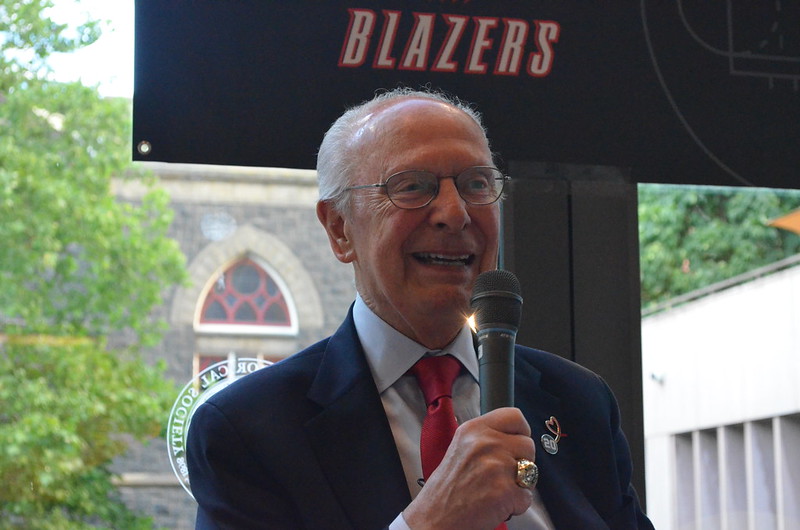
Something made Mr. Schonely and Bobby Gross smile, on live television!
  DSC_0390

The Schonz, beloved by all Portlanders and Oregonians, whether or not they are fans of NBA basketball. I took just a few photos because I wanted to concentrate on what was said, what Mr. Schonely shared with us. I think I grinned and/or smiled the entire time! What a treat!

And I got to talk to Mr. Schlueter again, for the third or fourth time starting last December, I've lost count. When I walked up to speak, he put his arm around my shoulder, drawing me in and following my, "Hi, Mr. Schlueter!" with "I saw you sitting over there!" Then we discussed the Trail Blazers' new general manager and our hopes for the upcoming season. Basketball heaven.

Wednesday, June 6, 2012

Irises set among the poppies at Schreiner's Iris Gardens, Salem, Oregon

poppy_iris_beds_of_flowers

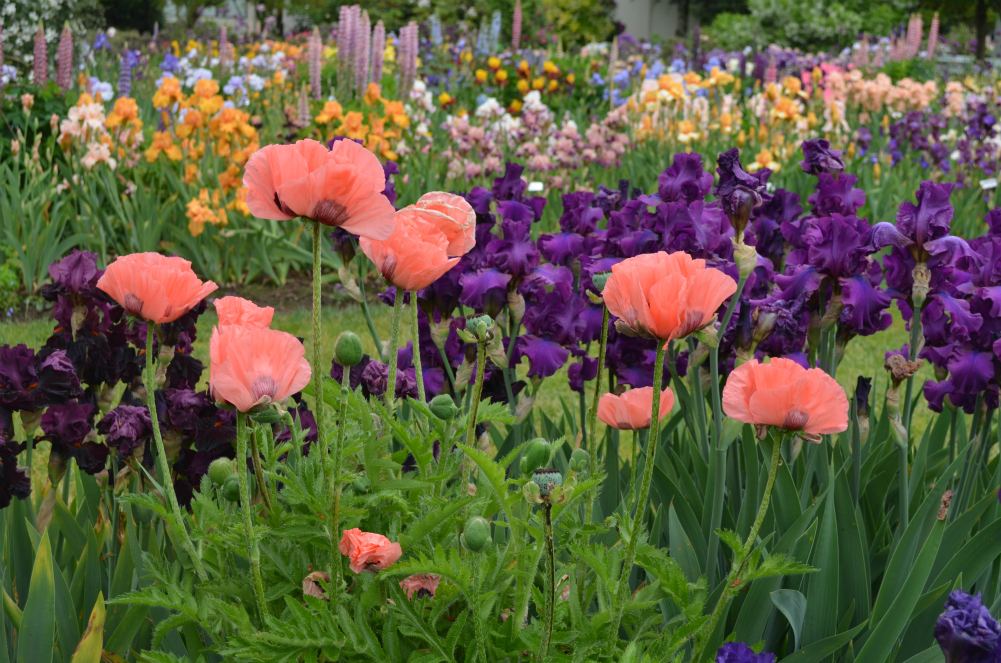
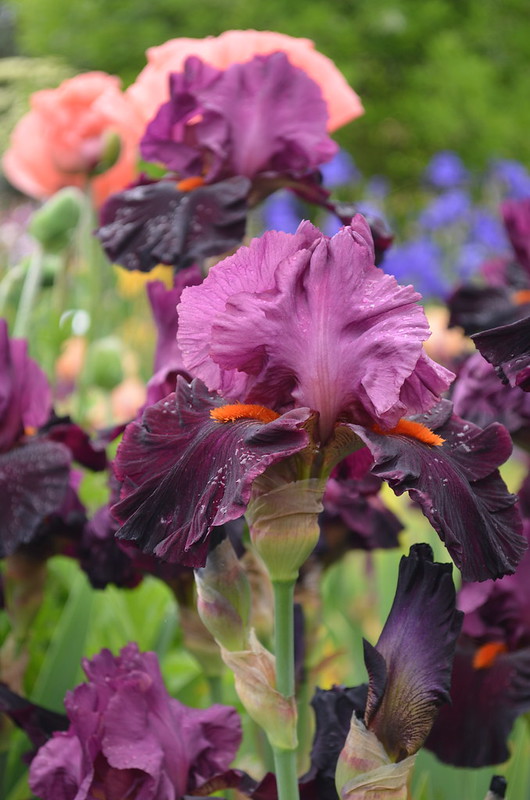
Poppy Oriental standing tall beside irises Fiery Temper on the left and Sultry Mood Iris on the right. And, there in the distance, more glorious color and shapes.

Sultry_Mood_iris_Schreiners_Iris_Gardens

Are you like me? When you visualize an iris, is it always a purple iris?


Well, let me tell you, after a few hours at Schreiner's Iris Gardens,  you won't have one bit of trouble visualizing all sorts of colorful irises. 


In honor of purple irises, here we go with the one named Sultry Mood, in a photo that I like a lot.


Here's a bit about Sultry Mood, from the Schreiner's online catalog. It's a tall bearded iris which grows to three feet tall. The color is listed as raspberry-rose, and it was originated at Schreiner's in 1989.


Finally here's the text beneath the description, which I find quite appealing (the definition of cerise is a moderate red):


Immerse yourself in the luxurious appeal of Sultry Mood's entrancing cerise-purple tones. Its exquisite flower form epitomizes balance and symmetry. This sense of grace continues with finely branched stems, each bearing 8-10 well-placed buds.


DSC_0069


And here's a bit about Fiery Temper, from the online catalog. It's also a tall bearded iris which grows to three feet tall. The color is listed as wine-red, and it was originated by Keppel in 2001. 


Finally, here's the text beneath the description, equally appealing to me: Bright tangerine beards embody the spirit of this new wine-red bitone. The rosy dahlia purple of the standards balances the deep red wine of the falls. Rumbling ruffles add rhythmic energy. 


I found these definitions at Town and Country Iris Society online: Standards, upward arching petals of the flower. Falls, three downward curving lower petals (sepals) of the flower. Ruffles, bouncy, wavy or rolling form applied to the petals. Beard, thick bushy hairs on the upper part of each of the three falls. I think Fiery Temper is the perfect vision of these terms.


Seen a man with that color beard in real life? I have, here in Portland. Well, it was dyed that color, but who cares!


Way cool. 

Tuesday, June 5, 2012

William Barlow House, Clackamas County, Oregon, seen on the way home from Schreiner's Iris Gardens, Salem, Oregon


William_Barlow_House_Clackamas_County_Oregon_BeFunky

Perfect bookend to a delightful day spent among the blossoms. Once again, I had to turn around safely and make my way back to get a few photos. Well worth it, let me tell you. Especially when I looked at the photo in its original size and could read on that tiny white sign hanging above the porch steps: W. M. Barlow House. "Oh, boy!" I thought. Perhaps I will be able to find out about the house on the Internet!

Here are the bits which I found online about the house:

William Barlow House (or Barlow House) is a historic building in Clackamas County, Oregon, United States.

Barlow House was home to William Barlow, namesake of the city of Barlow and son of Samuel K. Barlow, who built the Barlow Road. The house is located south of Barlow, between Canby and Aurora on 99E. It was built in an Italianate style in 1885, and listed on the National Register of Historic Places on February 15, 1977. It now operates as a privately owned museum and is open by appointment.

Monday, June 4, 2012

Sam Brown House, Gervais, Oregon, seen on the way to Schreiner's Iris Gardens, Salem, Oregon


Sam_Brown_House_Gervais_Oregon_sharpen_resize_BeFunky

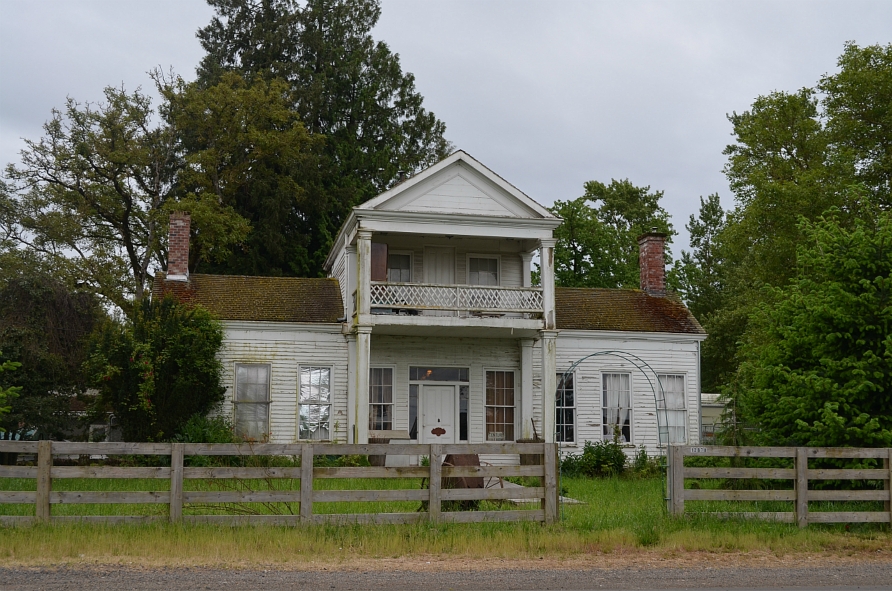
Memorial Day I drove out of Portland in the Zipcar named McMinnville, headed for the glories of Schreiner's Iris Gardens. On the way I drove by this house.

Immediately, I decided to turn around safely, head back the way I came, and then pull over for the opportunity to take a few photos, the first ones of that day. On the way home, satisfied hours later, I noticed big white barn back off the road and partially hidden by trees, to the right of the house as you see it in the photo. I read the words "The Willows, Sam H. Brown, 1921" in black letters on the front of the barn. "Oh, boy!" I thought. Perhaps I will be able to find out something online about the house.

Bits, I found these bits:

The Sam Brown House is a historic building located in Gervais, Oregon. It was constructed in 1857 for the former state senator and pioneer Samuel Brown. Built in a French Prairie area in the Classical Revival style of architecture, the Sam Brown House is believed to be the first home in the area to be worked on by an architect, as employing such experts weren’t exactly the trend yet back then. It was featured in 1986 in the August issue of the National Geographic Magazine. The article told the story of Samuel Brown and how he became an Oregon pioneer. The Sam Brown House became home to three generations of the family. Samuel Brown’s son, Sam, was also a local politician who became a state senator and ran unsuccessfully for the governor post in 1936.

Sam Brown House is a historic house in Gervais, Oregon, United States built in 1857 by Oregon pioneer and state senator Samuel Brown. Area: 2 acres (1 ha) Address: E of Gervais, Oregon Architectural styles: Neoclassical architecture, Classical Revival

Sam Brown House on Oregon Route 99E Location:12878 Portland Rd. NE Gervais, Oregon Architect: Sam Brown. Architectural style: Classical Revival. Added to NRHP:November 5, 1974