Downtown Portland's South Park Blocks often provide a backdrop for wedding photos--I've seen several. Just I lucked out with this photo on August 1, 2009. Just north of the statue of Abraham Lincoln, these fellows relax in the shade and sun, waiting patiently for their time in front of the wedding photographer's camera.

An individual's part in the global City Daily Photo Blog
Showing posts with label statue. Show all posts
Showing posts with label statue. Show all posts
Wednesday, January 22, 2014
Winter Opposites - No. 10, The men of the wedding party
Downtown Portland's South Park Blocks often provide a backdrop for wedding photos--I've seen several. Just I lucked out with this photo on August 1, 2009. Just north of the statue of Abraham Lincoln, these fellows relax in the shade and sun, waiting patiently for their time in front of the wedding photographer's camera.

Wednesday, June 27, 2012
Pray for those in the path of the wildfires and for those fighting the wildfires, and for those in the flood areas, too.
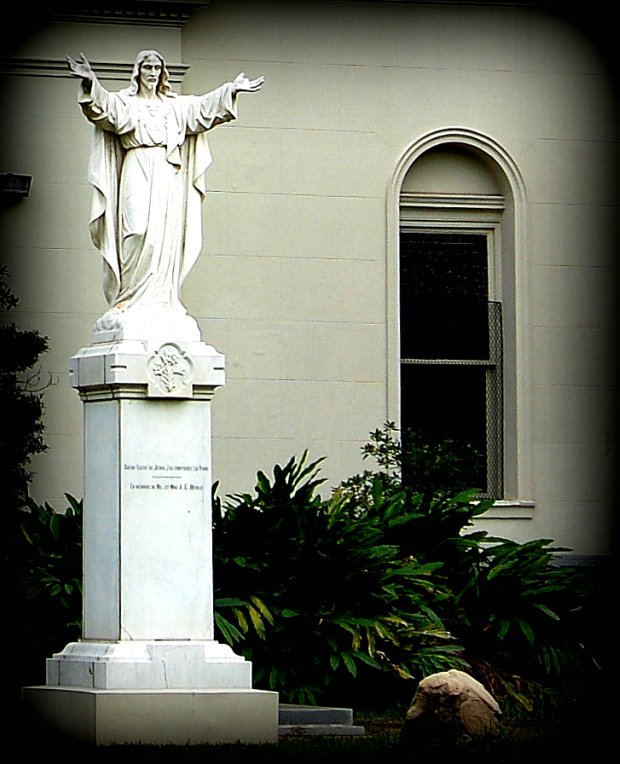
I can think of no other photo I have which would serve as a better call to increased prayers at this time than the statue of Jesus behind St. Louis Cathedral in the French Quarter.
About the statue, found on the Internet: While Hurricane Katrina did not affect the French Quarter as profoundly as other parts of New Orleans, the high winds managed to displace two large oak trees in St. Anthony's Garden behind the Cathedral. The trees dislodged thirty feet of ornamental gate, while the nearby marble statue of Jesus Christ lost only a forefinger and a thumb. Locals have already declared that the statue of Jesus sacrificed two fingers while flicking the storm away from the city and saving it from total destruction. (Hurricane Katrina was downgraded from a Category 5 to a Category 3 before landfall, when it made a turn to the north just before striking the Louisiana coast.)
This is a close-up of the one I took on Oct. 21, 2009.
Tuesday, August 11, 2009
Look what I saw while on the PCPA Tour Guide tour when we rode the MAX Yellow Line to learn about TriMet's public art on display!
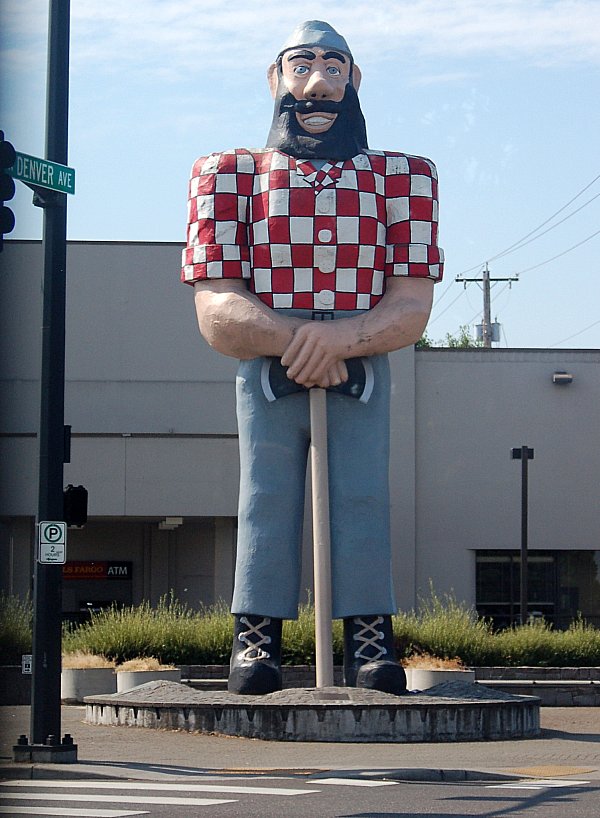
Yep! It's a Paul Bunyan statue! While he's not part of the TriMet public art on the MAX Yellow Line, he's certainly worthy of a post.
Here's what I found about him, online at The Oregonian:
North Portland's Paul Bunyan is officially historic
by Lynne Terry, The Oregonian
Monday February 09, 2009, 9:15 PM
It's official: North Portland's quirky Paul Bunyan has joined the National Register of Historic Places.
The 31-foot-tall statue, created in 1959 to mark Oregon's centennial, was recognized as a "well-crafted example of roadside architecture."
"It encapsulates how people thought about their state and where they lived in a set period of time," said Ian Johnson, historian at the State Historic Preservation Office.
There are more than 1,800 other landmarks in the state listed in the national register, from Timberline Lodge on Mount Hood to the USS Blueback submarine at the Oregon Museum of Science and Industry.
But the Paul Bunyan statue is Oregon's only roadside architecture in the register.
It was commissioned by the Kenton Businessman's Club to greet the millions of visitors to the Centennial Exposition, set up at the current-day Expo Center in North Portland at a time when Interstate Avenue was the main gateway to Portland.
"People were really proud of it," Johnson said. "Paul Bunyan was a really popular figure at the time. Even though Paul Bunyan is a Minnesota legend, it made sense to folks out here because the timber industry was really important in Oregon."
It was designed by a father and son team, Victor R. and Victor A. Nelson, who owned and operated the nearby Kenton Machine Works. They built the statue's steel structure and then moved it into place, finishing it off with concrete, plaster and paint.
"It was not inexpensive or easy to do," Johnson said. "It actually has quite a bit of craftsmanship." Unlike lesser lumberjacks that straddle roadsides in the U.S., this one has impressive detail, like molded shoe laces and buttons. The eyes are raised as well, and the pockets and belt loops were not just painted -- they were cut out.
The statue was nominated for the register in part by Maiya Martin, a University of Oregon student, and Bette Davis Nelson, the widow of Victor R. Nelson.
"I wanted to honor my husband," Nelson, 75, of Lake Oswego told The Oregonian last year. "Vic was so proud and thankful for the statue and what it stands for."
Last year, a businessman offered to buy the statue and move it to North Carolina. The Kenton Neighborhood Association, which owns the statue, ruled that out. In October, Oregon's State Advisory Committee on Historic Preservation voted unanimously in favor of the nomination. Being including in the National Register doesn't bring much besides bragging rights, Johnson said.
But there is only one other Paul Bunyan statue in the National Register, a relatively puny 18-footer in Bemidji, Minn.
Neither is exactly pretty. But if you're worried about that, you've missed the point.
"The National Register doesn't recognize beautiful things," said Johnson. "It recognizes historically important things. That's a big distinction."
Wednesday, November 28, 2007
ABC Wednesday – S is for Statue
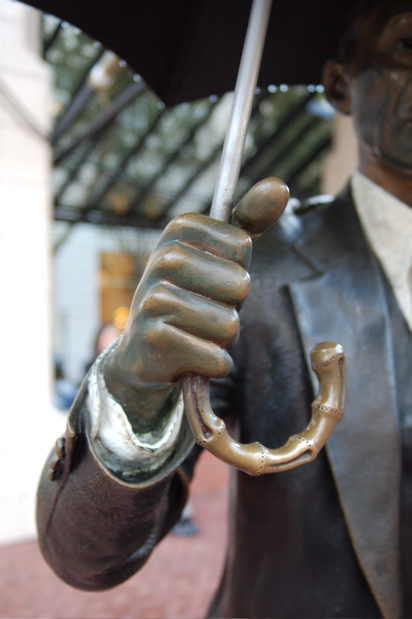
From Wikipedia: One of the more recognized pieces of public art in Portland is Seward Johnson's Allow Me, often popularly referred to as Umbrella Man. It is on the south side of the square, just above the amphitheater. Allow Me is a bronze statue of a man in a business suit, holding an umbrella and welcoming you with a friendly gesture.
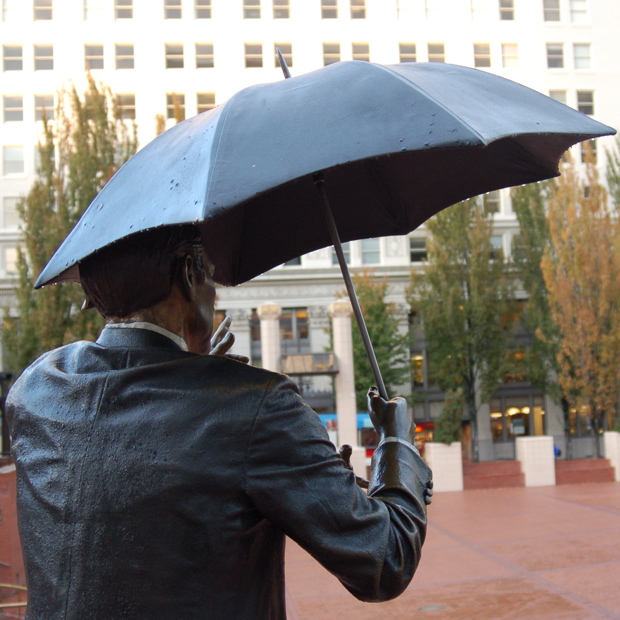
From Pioneer Courthouse Square dot org: Serving as a signature Portland icon, this bronze life-sized sculpture of a man offering his umbrella, was created by nationally known artist J. Seward Johnson of Princeton, New Jersey. The sculpture joins a number of Johnson's works in public spaces in cities such as New York, Kansas City, Los Angeles and Oakland, California.
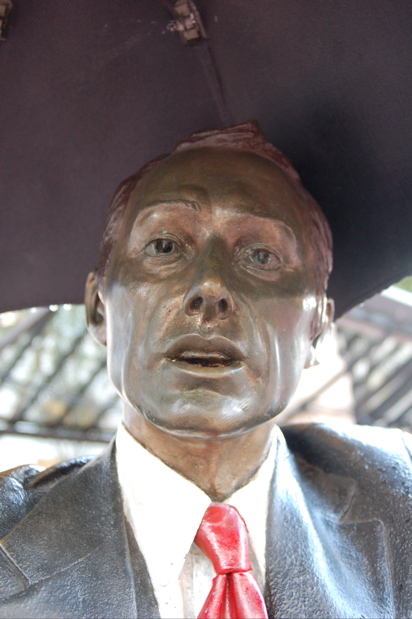
From Indopedia dot org: One of the more recognized pieces of public art in Portland is Seward Johnson's Allow Me. It is on the south side of the square, just above the amphitheater. Allow Me is a bronze statue of a man in a business suit, holding an umbrella and welcoming you with a friendly gesture.
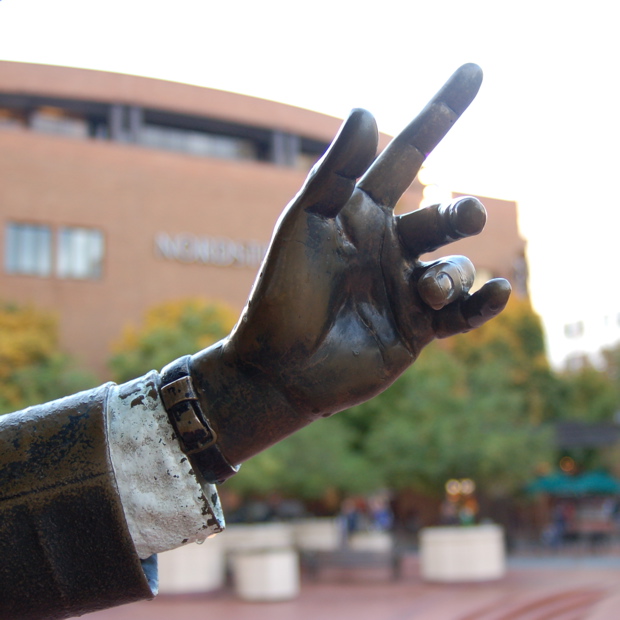
From Everything2 dot com: Above the larger amphitheater and towards the southwest corner of the square stands the beloved bronze statue, Allow Me (popularly known as the "umbrella man"), depicting a cheerful and friendly Portlander leaning forward to offer his umbrella. Tourists get their picture taken standing under his umbrella, campaign volunteers stick political stickers on his breast after rallies, and citizens of all types meet at his side.
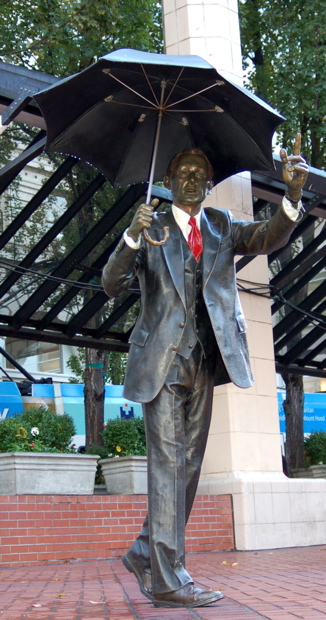
From Associated Content dot com: One of the highlights of Pioneer Square is the 'bronze man", a statue by renowned artist Seward Johnson. It is called "Allow Me" and is so real that visitors often mistake it for real. It is a favorite spot for photo sessions. No tourists goes away without a few pictures of themselves with the bronze guy.
Friday, September 14, 2007
In the midst of the Plaza Blocks
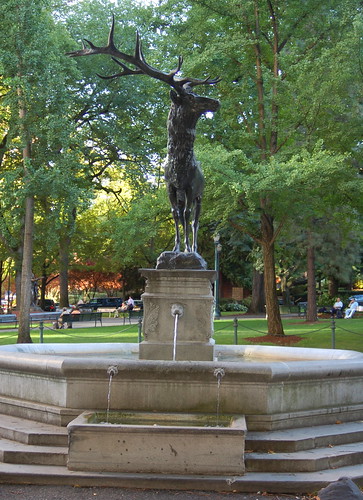
I'm always amazed when any bus I'm on slows down to circle this majestic statue. I love the fact that it's right in the middle of the street. For me, that's so Portland!
After work recently, as I walked through the area passing time before going to see "Spamalot," I took this picture, my back to the north. Here's what I found at the Portland Parks and Recreation Web site about this majestic statue/fountain which stands on Main Street, in between Chapman and Lownsdale Squares, better known as the Plaza Blocks:
Chapman Square is one of two courthouse squares that comprise the Plaza Blocks which are bounded by Third and Fourth Avenues and Salmon and Madison Streets. The south square is named for former Iowa territorial legislator and native Virginian William Williams Chapman (1808-1892) who arrived in Portland in 1850. An attorney with business interests, he also served as surveyor general of Oregon. In 1870, he sold this portion of his land claim to the city. The north square is named for Kentuckian Daniel H. Lownsdale, who settled in Portland in 1845 when there were fewer than 800 people living in the city.
The Plaza was a lively place where orators held forth and citizens assembled. They are characterized in part by several large old elms and gingko trees. Chapman Square, originally designed for the exclusive use of women and children, features all female gingko trees. Lownsdale Square was to be the "gentlemen's gathering place." Today the Plaza Blocks are still a busy gathering place, although men and women can now safely coexist in either of them.
Chapman Square has a Spanish-American War memorial: Fountain for Company H, installed in 1914, was donated by the mothers, sisters, and wives of Company H of the Second Oregon Volunteers. John H. Beaver, an architectural draftsman, won the honor of designing the limestone fountain and a $50 prize in a citywide contest. Also found in Chapman Square is a bronze statue commissioned by the Oregon Trail Coordinating Council to commemorate the 150th anniversary of the Oregon Trail which took place in 1993. The Promised Land, by Oregon artist David Manuel, depicts a pioneer family - father, mother, and son - at the end of their journey. The red granite slab upon which the statue is mounted is inscribed with a quote by Thomas Jefferson. The plaza in front of the statue is sandblasted with footprints reminiscent of pre-settlement days: jackrabbit, black bear, porcupine, grouse, coyote, elk, and moccasin prints.
Between the two Plaza Blocks, Main Street curves around a huge elk fountain given to the city by David P. Thompson. Thompson arrived in Portland driving sheep over the Oregon Trail. He served as Portland's mayor from 1879-1882. One day looked out of the office window in his New Market Building at the Skidmore Fountain and decided that he wanted to dedicate a fountain to the city as well. Thompson commissioned Roland Hinton Perry, whose work adorns the Library of Congress and the dome of the Pennsylvania state capitol, and in 1900, he presented the city with a bronze elk fountain to commemorate elk that once grazed nearby. Local architect H.G. Wright designed the stone base of eastern granite, which included drinking troughs for horses and dogs. The Exalted Order of Elks refused to dedicate it because they considered the statue "a monstrosity of art." Many have tried to have Thompson's elk removed because it can be considered a traffic obstacle, but the elk statue remains. In 1974, after a debate about disturbing the blocks in order to complement the then-new General Services Building, Thompson's elk and the Plaza Blocks were designated as Historic Landmarks.
Subscribe to:
Posts (Atom)