Showing posts with label Spamalot. Show all posts

Saturday, September 15, 2007

What I got off the bus to see the other day

091507_tug_5x7_640x426

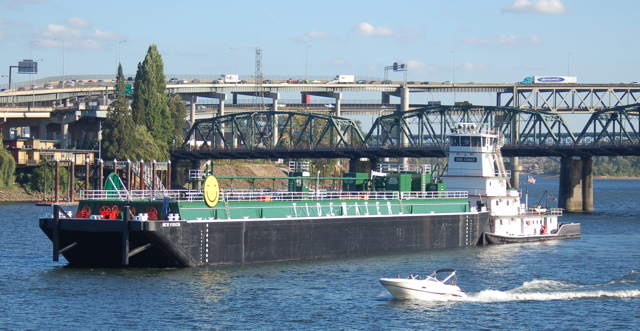
As the No. 14 bus headed west over the Hawthorne Bridge, I spied something I’d not yet seen in the 14 months I’ve lived in Portland. It's a barge named New Vision--I see that on the front corner of it--and a tug named The Chief, right in the middle of downtown, on the Willamette River. Neat!

I got right off that bus at its first stop and walked back east, heading north along the river. They were slowly moving downstream. I walked and walked and walked, until I could get the entire barge and tug in the photo.

Look at that blue sky, reflected in the river. Didn't I luck out at what I consider a momentous moment (sorry) in the story of my life in Portland? I think so. And did you know that the Willamette River runs north, to its mouth and the intersection with the Columbia River which then runs west to the Pacific Ocean? That's why I was walking north and the barge and tug were moving downstream.
091607_tug_bridges_640x332

Here's another angle. The green metal struss bridge is the Hawthorne Bridge, and the double deck cantilever bridge beyond it is the Marquam, home of I-5 as it crosses the river.

If you like ocean-going vessels, you ought to look at my other blog, Mama and Me from PDX, in the August Posts. Scroll on down to August 16 (which takes you by my Aug. 23 parody of "Always Look on the Bright Side of Life," which I entitled, "Always Delete the Spam from Your Life") to see a huge yacht at the marina on the other side of the Hawthorne Bridge.

Here's a tidbit from the barge company’s Web site:

Tidewater—more than a barge line. In operation since 1932, Tidewater has traditionally offered a variety of barge transportation services on the Columbia-Snake River System. Today, in our endeavor to provide extended services to our customers, Tidewater has evolved into a multi-modal transportation company serving the Pacific Northwest with its integrated system of towboats, barges, and terminals. We appreciate the privilege of operating in the Pacific Northwest and are committed to performing in a manner that will preserve the livability of this region for future generations.

Friday, September 14, 2007

In the midst of the Plaza Blocks

091407_deer_elk_dontknow

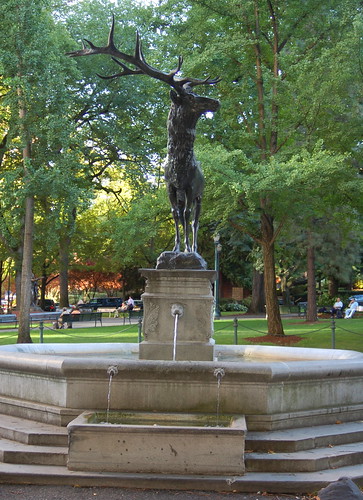
I'm always amazed when any bus I'm on slows down to circle this majestic statue. I love the fact that it's right in the middle of the street. For me, that's so Portland!

After work recently, as I walked through the area passing time before going to see "Spamalot," I took this picture, my back to the north. Here's what I found at the Portland Parks and Recreation Web site about this majestic statue/fountain which stands on Main Street, in between Chapman and Lownsdale Squares, better known as the Plaza Blocks:

Chapman Square is one of two courthouse squares that comprise the Plaza Blocks which are bounded by Third and Fourth Avenues and Salmon and Madison Streets. The south square is named for former Iowa territorial legislator and native Virginian William Williams Chapman (1808-1892) who arrived in Portland in 1850. An attorney with business interests, he also served as surveyor general of Oregon. In 1870, he sold this portion of his land claim to the city. The north square is named for Kentuckian Daniel H. Lownsdale, who settled in Portland in 1845 when there were fewer than 800 people living in the city.

The Plaza was a lively place where orators held forth and citizens assembled. They are characterized in part by several large old elms and gingko trees. Chapman Square, originally designed for the exclusive use of women and children, features all female gingko trees. Lownsdale Square was to be the "gentlemen's gathering place." Today the Plaza Blocks are still a busy gathering place, although men and women can now safely coexist in either of them.

Chapman Square has a Spanish-American War memorial: Fountain for Company H, installed in 1914, was donated by the mothers, sisters, and wives of Company H of the Second Oregon Volunteers. John H. Beaver, an architectural draftsman, won the honor of designing the limestone fountain and a $50 prize in a citywide contest. Also found in Chapman Square is a bronze statue commissioned by the Oregon Trail Coordinating Council to commemorate the 150th anniversary of the Oregon Trail which took place in 1993. The Promised Land, by Oregon artist David Manuel, depicts a pioneer family - father, mother, and son - at the end of their journey. The red granite slab upon which the statue is mounted is inscribed with a quote by Thomas Jefferson. The plaza in front of the statue is sandblasted with footprints reminiscent of pre-settlement days: jackrabbit, black bear, porcupine, grouse, coyote, elk, and moccasin prints.

Between the two Plaza Blocks, Main Street curves around a huge elk fountain given to the city by David P. Thompson. Thompson arrived in Portland driving sheep over the Oregon Trail. He served as Portland's mayor from 1879-1882. One day looked out of the office window in his New Market Building at the Skidmore Fountain and decided that he wanted to dedicate a fountain to the city as well. Thompson commissioned Roland Hinton Perry, whose work adorns the Library of Congress and the dome of the Pennsylvania state capitol, and in 1900, he presented the city with a bronze elk fountain to commemorate elk that once grazed nearby. Local architect H.G. Wright designed the stone base of eastern granite, which included drinking troughs for horses and dogs. The Exalted Order of Elks refused to dedicate it because they considered the statue "a monstrosity of art." Many have tried to have Thompson's elk removed because it can be considered a traffic obstacle, but the elk statue remains. In 1974, after a debate about disturbing the blocks in order to complement the then-new General Services Building, Thompson's elk and the Plaza Blocks were designated as Historic Landmarks.