Showing posts with label PCPA Tour Guides. Show all posts

Monday, August 17, 2009

More of the PCPA Tour Guides tour of public art on the MAX Yellow Line

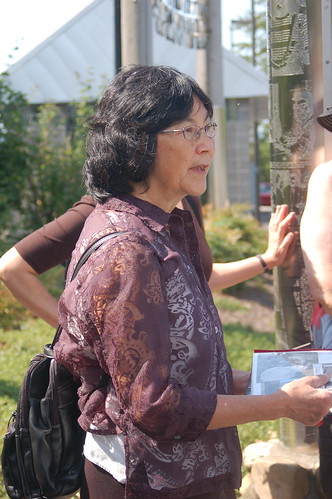
At the end of the Yellow Line, we followed our guide Valerie Otani off the MAX at the Expo Center Station. This particular public art is mainly Valerie's. Facts from TriMet's Web site.

DSC_0057
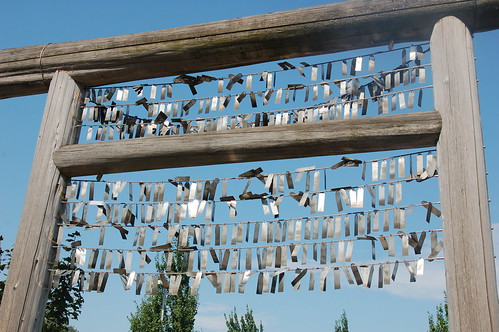
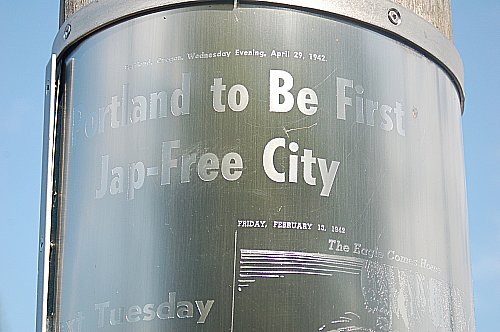
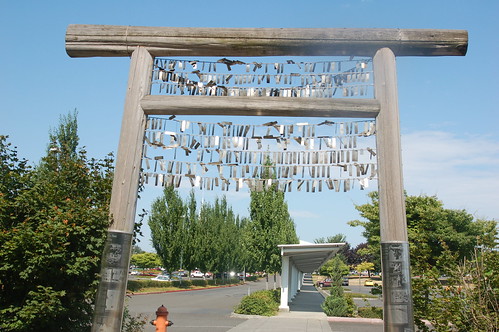
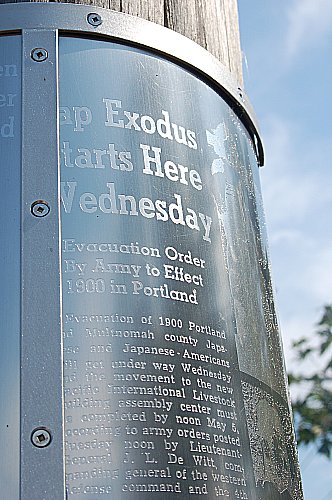
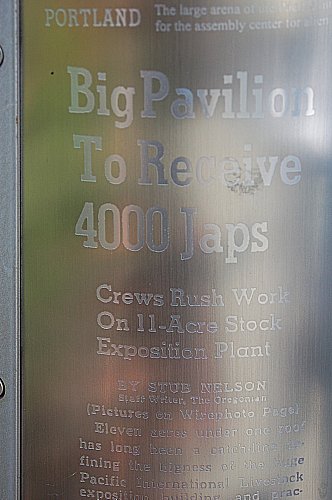
Valerie Otani addresses the theme of Japanese relocation during World War II at the site of the 1942 Portland Assembly Center.Traditional Japanese timber gates strung with metal "internee ID tags" mark station entrances. Vintage news articles are etched in steel and wrapped around the gate legs.
DSC_0051_picnicked

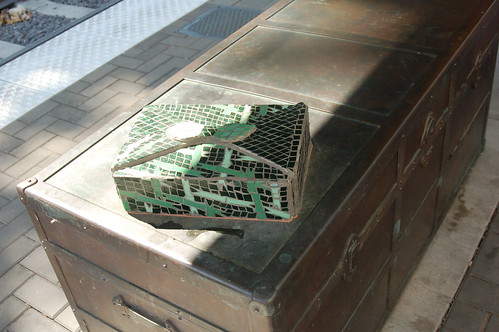
Bronze trunks provide seating on the platforms.
DSC_0034

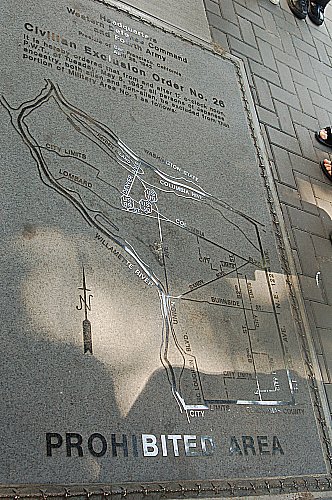
Community maps feature the floor plan of the converted livestock exhibition hall and a copy of the exclusion order.
DSC_0036_picnicked

Info from the PCPA Volunteers Newsletter:
DSC_0038
Expo Center station was perhaps the most meaningful of our trip. Valerie Otani was the artist and she designed large timber gates reminiscent of those found in Asia. The gates reflect a transition, or an entrance, or beginning. The Expo Center was historically a livestock yard, but was converted into a temporary WWII internment center for those of Japanese descent.

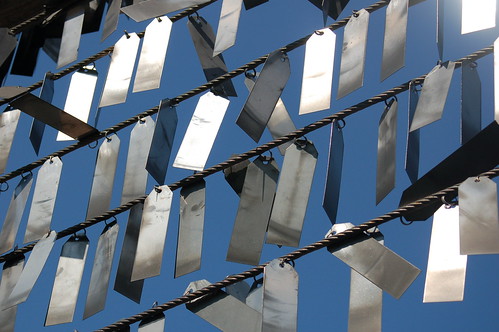
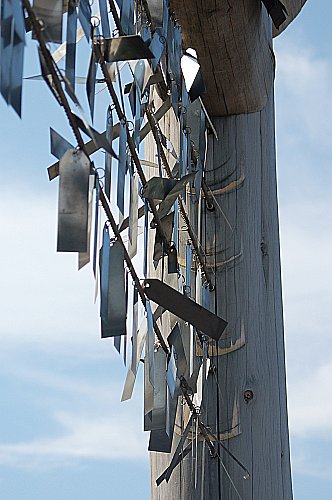
At the top of the large gate are 4000 metal tags in commemoration of the 4000 internees located there. The tags resemble the ID tags required for all Japanese to wear.
DSC_0050

DSC_0053_picnicked

The base of each gate is wrapped in metal to protect its wooden structure – since this is art for the public and must be able to withstand public use. Some metal wrappings are etched with actual newspaper accounts of the time of internment which are shocking (and saddening) to our eyes.

DSC_0046_picnicked

DSC_0056_picnicked

DSC_0048
Ms. Otani is of Japanese descent and told us of her family’s story. Her immediate family lived in California and they were interned there. Her grandfather had lived in Hawaii for 30 years before the night of Pearl Harbor when he, and other leaders in the Japanese community, were arrested. He returned to Japan after the war and never saw his U.S. family again.

Tuesday, August 11, 2009

Look what I saw while on the PCPA Tour Guide tour when we rode the MAX Yellow Line to learn about TriMet's public art on display!

DSC_0028_paul _bunyan
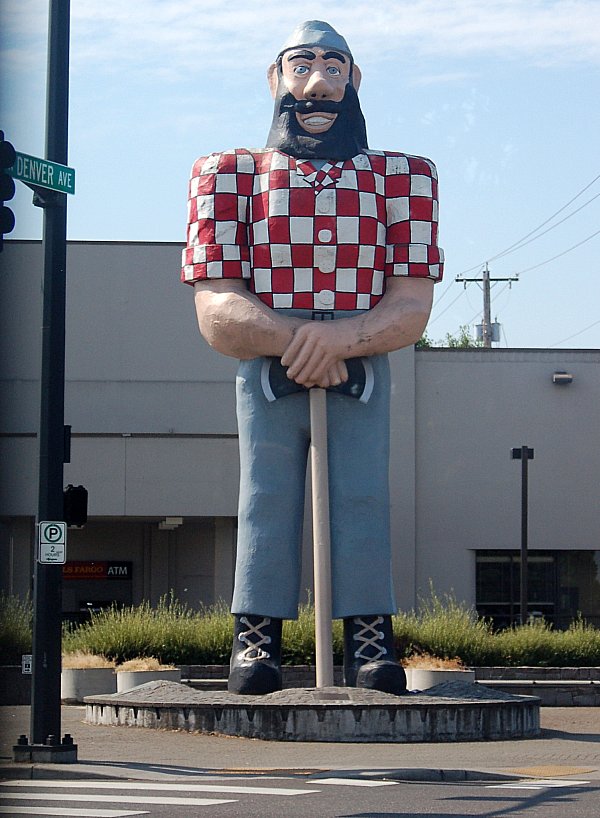
Yep! It's a Paul Bunyan statue! While he's not part of the TriMet public art on the MAX Yellow Line, he's certainly worthy of a post.

Here's what I found about him, online at The Oregonian:
North Portland's Paul Bunyan is officially historic
by Lynne Terry, The Oregonian
Monday February 09, 2009, 9:15 PM

It's official: North Portland's quirky Paul Bunyan has joined the National Register of Historic Places.

The 31-foot-tall statue, created in 1959 to mark Oregon's centennial, was recognized as a "well-crafted example of roadside architecture."

"It encapsulates how people thought about their state and where they lived in a set period of time," said Ian Johnson, historian at the State Historic Preservation Office.

There are more than 1,800 other landmarks in the state listed in the national register, from Timberline Lodge on Mount Hood to the USS Blueback submarine at the Oregon Museum of Science and Industry.

But the Paul Bunyan statue is Oregon's only roadside architecture in the register.

It was commissioned by the Kenton Businessman's Club to greet the millions of visitors to the Centennial Exposition, set up at the current-day Expo Center in North Portland at a time when Interstate Avenue was the main gateway to Portland.

"People were really proud of it," Johnson said. "Paul Bunyan was a really popular figure at the time. Even though Paul Bunyan is a Minnesota legend, it made sense to folks out here because the timber industry was really important in Oregon."

It was designed by a father and son team, Victor R. and Victor A. Nelson, who owned and operated the nearby Kenton Machine Works. They built the statue's steel structure and then moved it into place, finishing it off with concrete, plaster and paint.

"It was not inexpensive or easy to do," Johnson said. "It actually has quite a bit of craftsmanship." Unlike lesser lumberjacks that straddle roadsides in the U.S., this one has impressive detail, like molded shoe laces and buttons. The eyes are raised as well, and the pockets and belt loops were not just painted -- they were cut out.

The statue was nominated for the register in part by Maiya Martin, a University of Oregon student, and Bette Davis Nelson, the widow of Victor R. Nelson.

"I wanted to honor my husband," Nelson, 75, of Lake Oswego told The Oregonian last year. "Vic was so proud and thankful for the statue and what it stands for."

Last year, a businessman offered to buy the statue and move it to North Carolina. The Kenton Neighborhood Association, which owns the statue, ruled that out. In October, Oregon's State Advisory Committee on Historic Preservation voted unanimously in favor of the nomination. Being including in the National Register doesn't bring much besides bragging rights, Johnson said.

But there is only one other Paul Bunyan statue in the National Register, a relatively puny 18-footer in Bemidji, Minn.

Neither is exactly pretty. But if you're worried about that, you've missed the point.

"The National Register doesn't recognize beautiful things," said Johnson. "It recognizes historically important things. That's a big distinction."

Friday, August 7, 2009

Public art on the MAX Yellow Line--seen from the light rail train

All facts found at TriMet's Web site, including the story of the Yellow Line at the bottom of this post, and this about Art on Interstate MAX Yellow Line

Artwork at every stop along the MAX Yellow Line draws from the history and culture of the area to create a unique identity for each station.

With over 40 local artists contributing artwork and 75 community members participating in forums and committees, the art along MAX Yellow Line is a proud reflection of a historically rich and vital part of Portland.


We boarded a train around 10 a.m. for our two-hour tour. I couldn't get every shot I wanted due to being inside a moving train car, so I missed art at some stations completely, and at other stations, I only got tidbits. To have done a better job, I would have had to get off at every stop, walk around, look, take photos, wait for the next train. Since I had an appointment for a haircut and perm, and since I was part of an organized tour, I was a good girl and stayed with our tour guide Valerie Otani's plan. I am very glad that I did, but one of these days I want to go back and take a more in-depth look.
DSC_0145_rose_garden_art
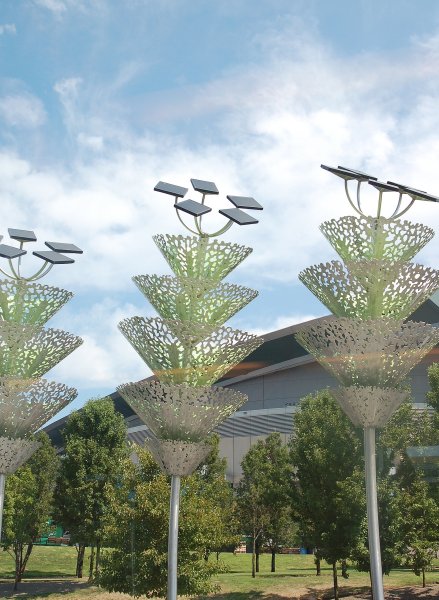
Interstate/Rose Quarter Station: Brian Borrello presents a three-part metaphor for displacement and change. Illuminated metal trees generate their own electricity from solar panels.
DSC_0154_rose_garden_stumps
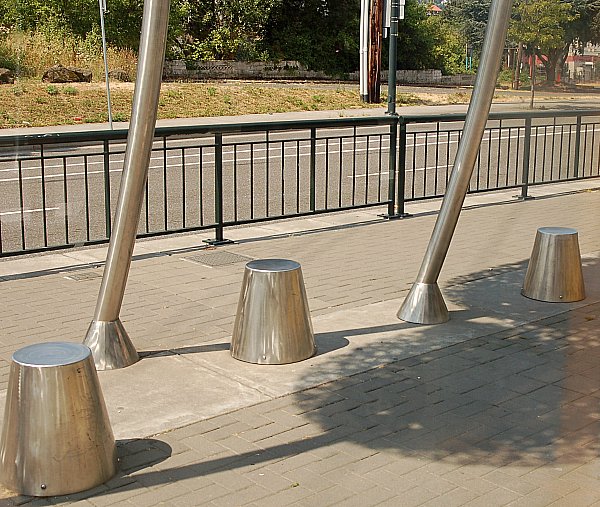
A virtual campfire flickers with light at night, surrounded by stainless steel stump seats.

max_art_tracks_wide
Wide view.

DSC_0019
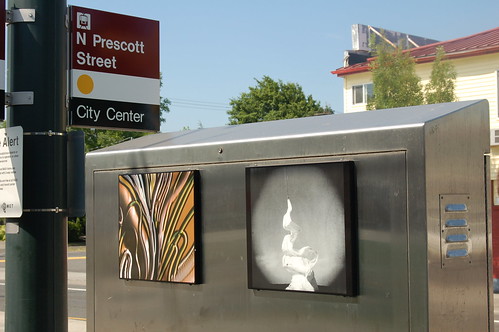
N. Prescott St. Station: Works by Wid Chambers and Heidi Kirkpatrick are reproduced in porcelain enamel on steel. (I don't know which is which. Valerie explained that the idea was to open the public art up to more than sculptors with these works on TriMet's boxes that contain something important to the trains, can't remember what exactly.)
DSC_0021
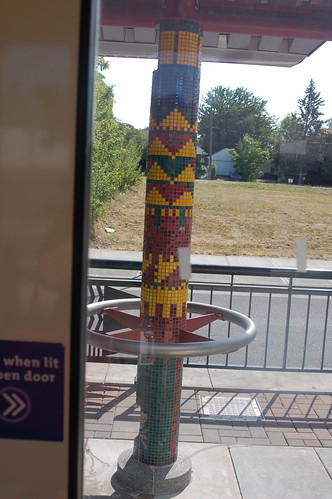
N. Killingsworth Station: Adriene Cruz and Valerie Otani celebrate the vibrant multiculturalism of the Killingsworth community. Glass mosaic on columns recalls the colorful patterns of African Kente cloth.
DSC_0121
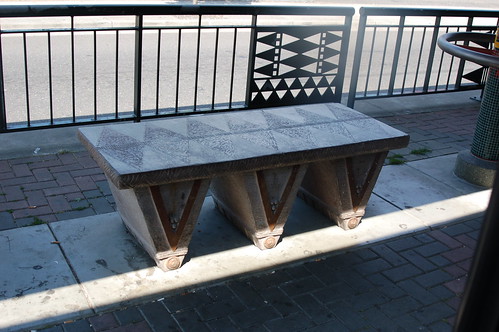
Guardrail panels were inspired by South American textiles. Cast-concrete benches evoke the carved wooden stools of Africa.

The MAX Yellow Line is a 5.8-mile (9.3 km) (not including segments downtown shared with other lines) route in the Metropolitan Area Express light rail system in Portland, Oregon. The route, which opened May 1, 2004,[1] runs between downtown Portland and the Portland Expo Center. It is also known as the Interstate MAX because the majority of the line runs along Interstate Avenue in North Portland.

The Yellow Line is the newest MAX line currently in full operation. Originally, it was conceived as part of a north-south light rail project between Vancouver, Washington, and Milwaukie to be built using city funds, but that plan was rejected by voters. TriMet then learned that a majority of the residents of North Portland had voted in favor of the original plan, so they decided to build this new line without using city funds. To do this, they convinced the City of Portland to create an urban renewal district along the proposed line, which made them eligible for matching federal funds with which they could finance the construction of the MAX line. The project was finished four months ahead of schedule at a budget of $320 million, $25 million under budget.[1] The presence of the line has also caused a great deal of redevelopment along its corridor.

The Yellow Line will move to the Portland Transit Mall on August 30, 2009.[2] Additionally, there are plans for extensions at both ends, from downtown Portland southward to Milwaukie as part of the so-called MAX Orange Line (which will likely be a Yellow Line extension), and from the Expo Center into Vancouver, Washington, via Interstate 5 and SR-500.