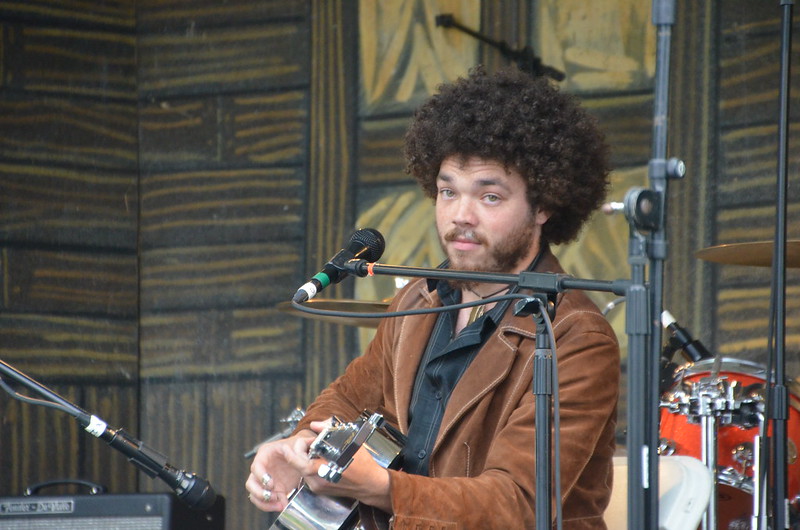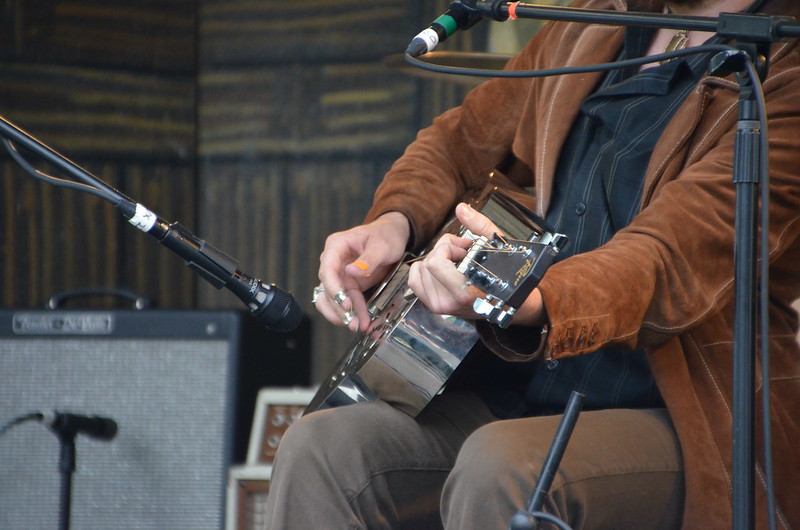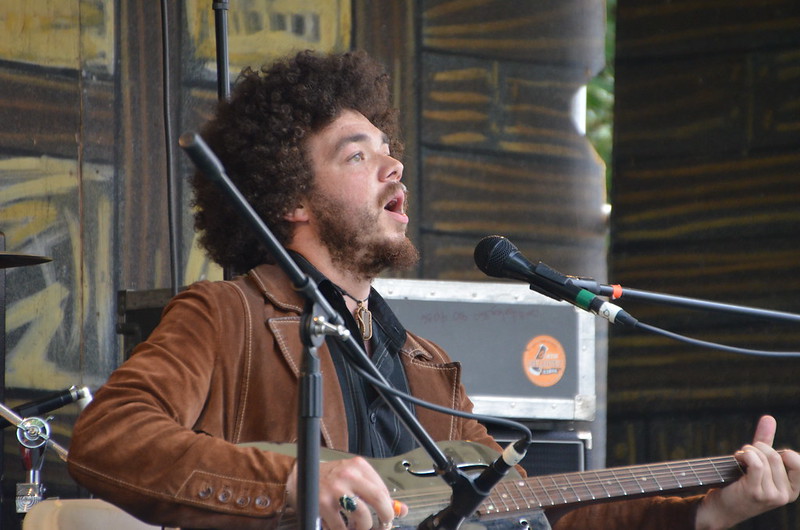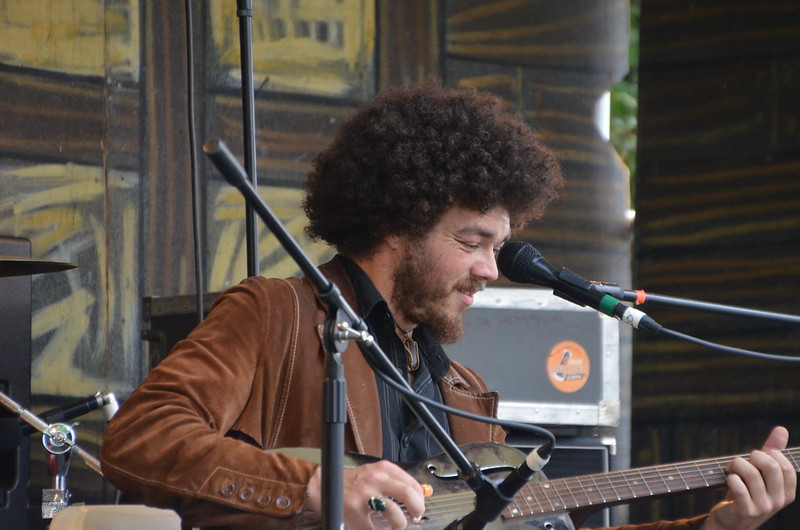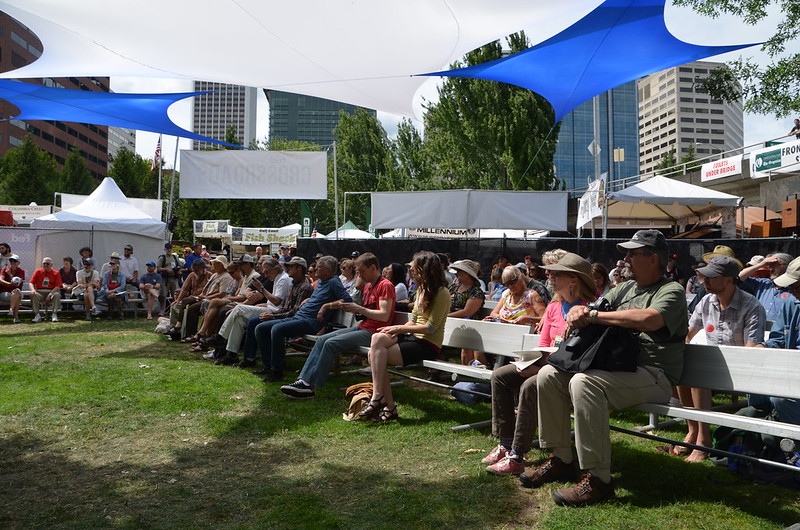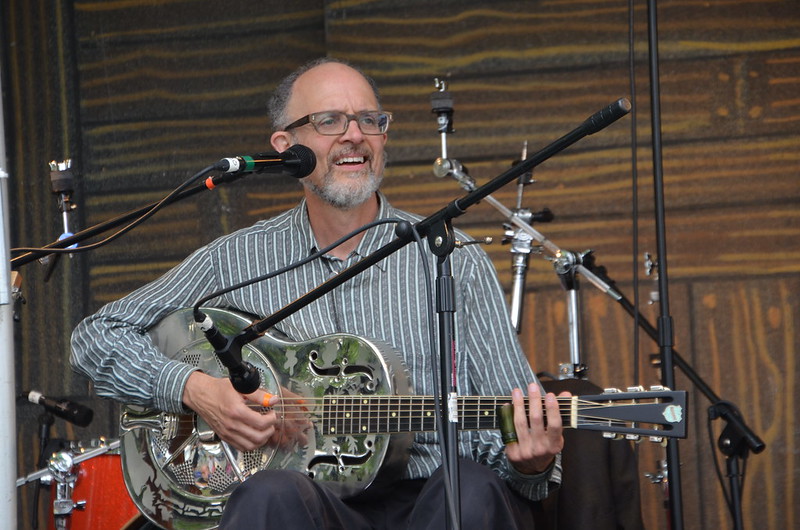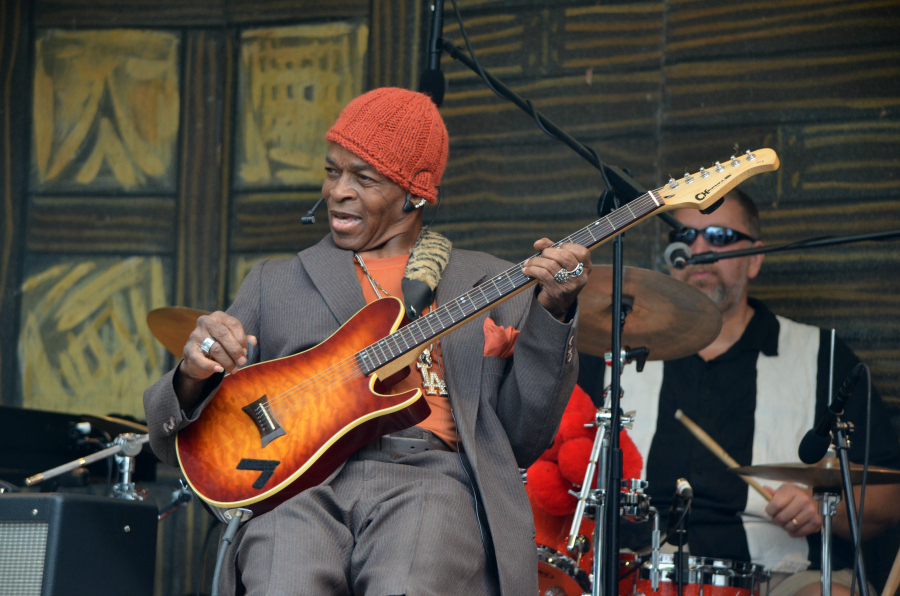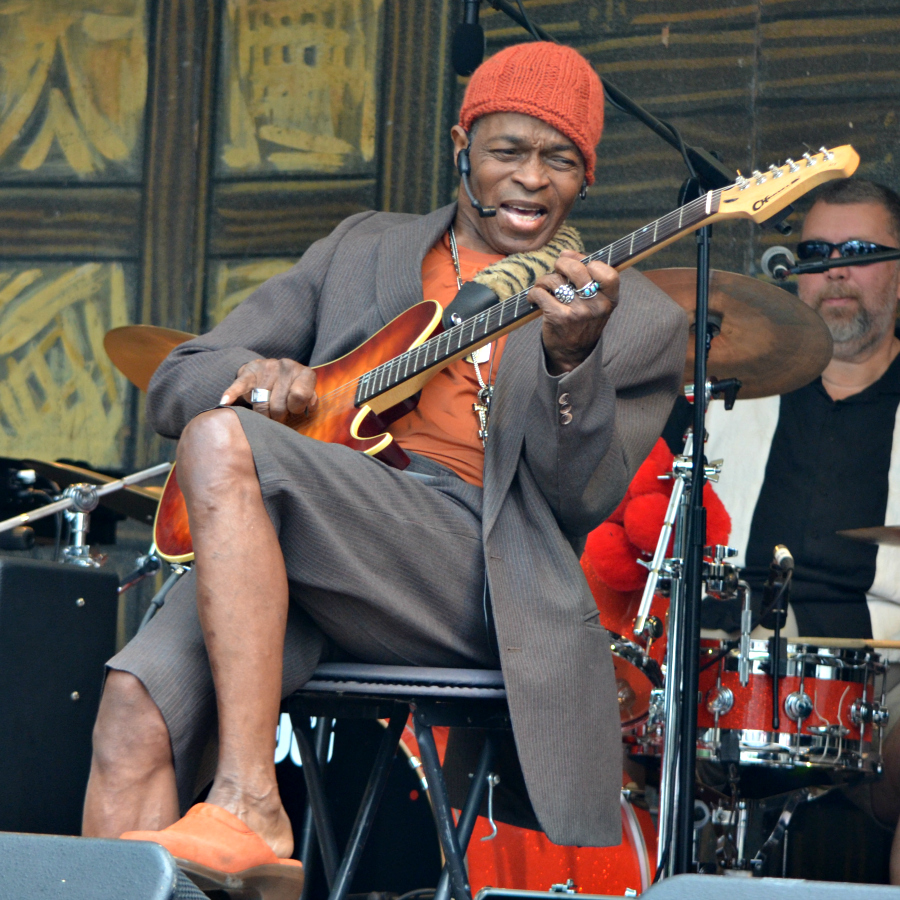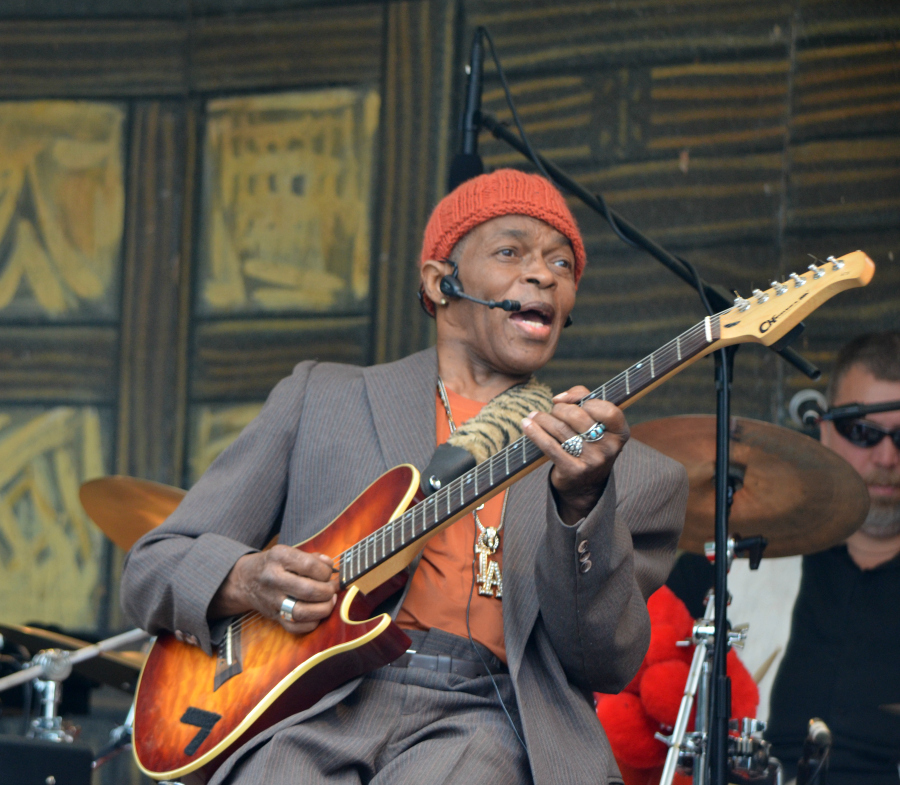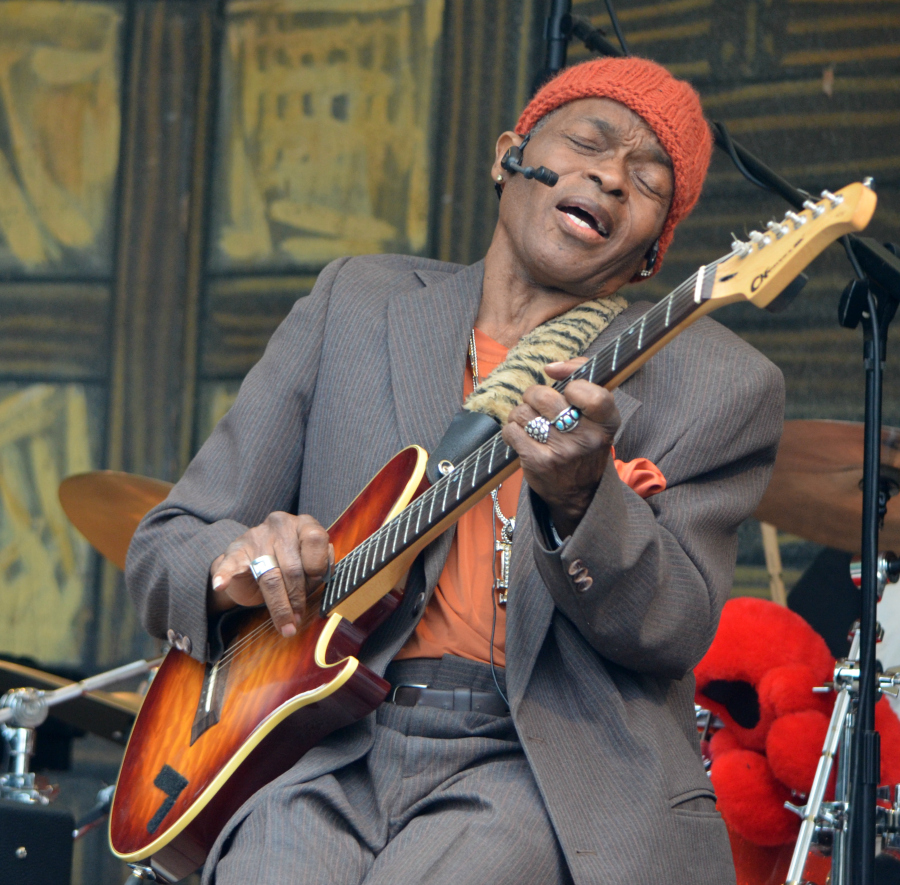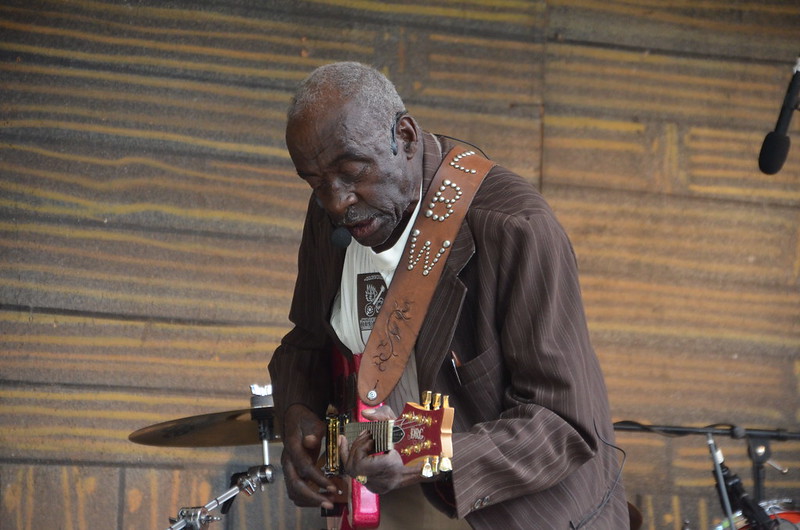
Despite his age and posture impacted by the passage of time, Welch took over the FedEx Crossroads Stage and grabbed hold of the audience as he played and sang, either from a folding chair or as he stepped across the stage, turned and made his way back to the chair. Mississippi country blues at its best, y'all.
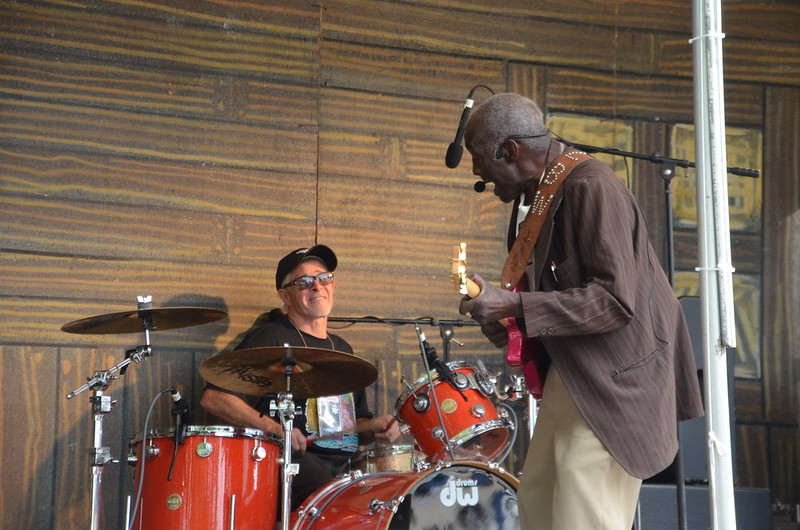
I took quite a few photos of Leo "Bud" Welch on guitar, singing. Some of the photos include fellow music-man-from-Mississippi Stan Street on drums. For me, this particular photo shows the enjoyment and mutual respect comes to each man as they perform together.
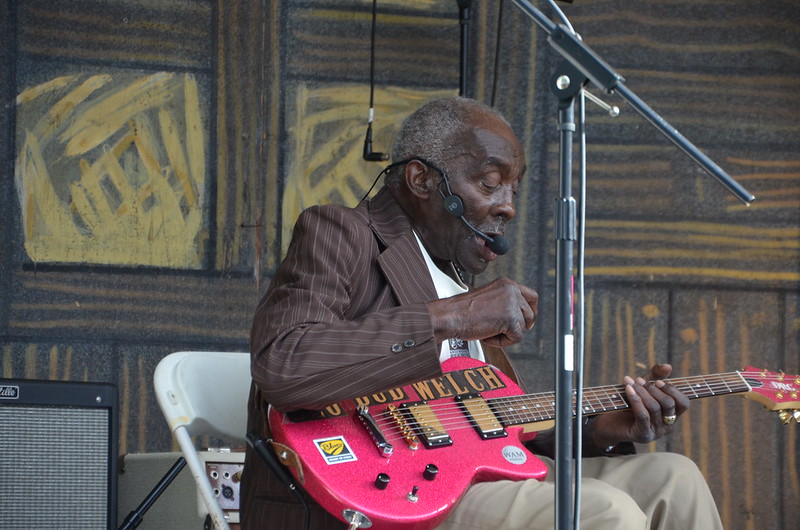
Here's the bio I found for Welch at the Safeway Waterfront Blues Festival's Web site:
The new year is a time of new beginnings, new resolutions, new projects and new directions. So it's seems appropriate that Leo “Bud” Welch, at the age of 81, to put out his very first record in early January.
Welch has been playing gospel and blues around the tiny town of Bruce, Miss., for decades. He was a local standout unknown to the outside world—until he called up Oxford, Mississippi-based label Fat Possom, went in for an audition, and signed a record deal on the spot with the label’s subsidiary, Big Legal Mess. The album, Saboulga Voices, has been featured on NPR, drawn accolades in the blues press, and landed Welch invites from major blues festivals. Raved NPR, “It’s quite a joyous kick, with the raw boogie of Junior Kimbrough and other Mississippi Hill Country blues greats, but also a fiery religious undercurrent that’s about as far from grace as you can get while still under the church tent.”
Not the kind of newly-discovered buzz-act who is going to hop in a tour van for weeks on end, Leo “Bud” Welch is nonetheless making the most of his sudden celebrity. In addition to his stop at Waterfront he’ll be playing the Vancouver Island Music Festival in British Columbia a few days later, with a likely gig in Seattle on the way.
Born in Sabougla, Mississippi in 1932, Welch picked up his cousin’s guitar for the first time when he was 13, and two years later was performing locally. Welch was offered an audition by BB King but couldn’t afford the bus trip to Memphis. He played the blues continuously until 1975, when he converted to playing mostly Gospel, with the Sabougla Voices, which consisted of his sister and a sister-in-law. Welch also played with the Skuna Valley Male Chorus. Bud earned his living by carrying a chain saw up and down the hills and hollows of North Mississippi, logging for 35 years. Welch does not believe that Blues is the “devil’s music” but rather a way of expressing the highs and lows of one’s life through song. Though happy to talk about his earlier life Welch proudly notes that he has never had to worry about hangovers since he began singing gospel.
And here's another bio that I found at The Country Blues Web site--with much more about Welch's life and career, plus what's next:
The old blues lyric so aptly states, “There are strange things, strange things happening every day.” We’ve seen 13 year old blues prodigies out touring the festivals and 93 year old bluesmen still on the road, mostly because they couldn’t afford to retire. Plenty of blues and soul musicians turned to gospel and stopped secular music in favor of the sacred. Yet, it would be hard to match the unique case of bluesman Leo Bud Welch from down in Bruce, Mississippi. He entered the blues scene at the ripe old age of 81 after having played lead guitar and sung in church since 1975. In this unlikely case, the late in life emergence of an octogenarian bluesman is actually good news for the blues and for the artist, whose spent a lifetime in music.
Leo Bud Welch does not hear too well, so he plays an electric guitar with a headset and monitors, yet his music is pure Mississippi country blues. “They don’t make the acoustic guitars like they used to, they used to be louder,” says the blues bard, a fact which may be more attributable to his hearing than the state of instruments today. He plays fingerstyle on a bright pink guitar, which at first glance may seem unusual, but it is a statement in solidarity with breast cancer awareness, a disease that has afflicted so many families, including his own. He’s also played fiddle and harmonica, and he sings with a clear and strong voice, belying his age. There is an ethereal, deep quality to his music, a man whose blues is deep from a lifetime in the Mississippi timber fields. His sudden emergence took the world by surprise, and then his career took off like a rocket.
Like many musicians, he came from a musical family and first picked up the instrument from kinfolk when he was a young kid. He learned from his first cousin R.C. Welch with whom he would later play picnics and house parties. Before 1975, he was a true folk-blues musician, playing with his cousin at locally at gatherings, celebrations and wherever the community gathered, mostly for little or no money. He worked a hard day job in the logging industry, cutting timber along the banks of the Mississippi River and played music on the side. “I done some hard work. Some really hard work. The music we did on the side for fun.” Like most musicians at the time, the pair were very much songsters. “We played everything including what the white people liked to hear. We played hillbilly and everything. Whatever the people liked to hear, we played the songs for them to make them happy.”
He is well known in the African American gospel world around his hometown Sabougla, Mississippi, a tiny rural enclave in central Mississippi, often not even shown on the map. There he played in the Missionary Baptist Church, and in Webster County, Mississippi at the Double Spring Church, where he is a Deacon, and leader of congregational songs. Since emerging himself in gospel, Welch has played with the Sabougla Voices and the Skuna Valley Male Chorus. Among his many pursuits, he was the host of a gospel television show, in the local Bruce station, in a show featuring videos of local church gospel performances. All of that seems a long way from the blues, but true blues lovers know that the gospel/spiritual element has always been an important part of the blues, with a long songbook of sacred songs. To date, he plays both gospel-blues and secular blues, and sometimes the congregants give him the business about “taking the devil’s money” for playing blues, which he laughs off and takes in stride, saying, “Well, at least this time I’m getting paid.” He told the Memphis Flyer, “I don’t see where there’s no devil in the blues,” Welch says. “They do more devilsome things than that. Oh yeah.”
After 27 years of playing strictly gospel in the center of the church music ensemble, he emerged on the blues scene and surprised the world. His first album Sabougla Voices on Fat Possum got him featured on the US National Public Radio (NPR), a feat that many famous musicians who have been active on the blues scene have not reached. He got help on the album from Jimbo Mathus, among others. Through it all, Leo holds tight to his faith. The opening cut Praise His Name says it all, with Welch putting down a Rosetta Tharpe type rocking riffs and energetic leads taking from both the Mississippi Delta and Hill Country style.
Leo had a remarkable reception in the roots & blues community because he’s not just an excellent guitarist but a consummate showman. He gives you the old blues going back to the 1940s, often backed by just a drummer, lately by Dixie Street. Unlike most of the older generation players, he does not sit and prefers to walk the stage to connect with his audience, an uncanny showman, a skill he carried over from a lifetime as a performer.
Much of the credit for the mercurial rise is due to his manager and friend, Vencie Varnado, who has known Leo for all of Vencie’s life. He is helping Leo through all this and guiding his career as an honest broker, a true friend. By now, Leo Bud Welch is internationally famous, actively touring the major folk, blues and roots festivals in the US, Canada and Europe. It is a friendship based on longtime community links.
It all had a funny start. While most people would assume Bud to be too old, Vencie realized that it is never too late in life. He had asked Leo to perform at his birthday party and he secretly recorded the performance, and sent the demo to send to a record label indie label Big Legal Mess, owned by Bruce Watson of Fat Possum Records, who has an uncanny history of picking up unsung, under the radar roots musicians and realizing their value, long before others recognize them. Think Jr. Kimbrough.
Amazingly, this story is not over…Leo Bud Welch is still touring and seemingly full of energy. But, Vencie makes it clear: “I will not allow Leo to get exploited. He’s going strong now. He is enjoying himself. I will make sure that nobody will ever push him out on stage when he is no longer up to it. There is too much of that, when people make money off the old guys. That’s not going to happen to Leo. I don’t need it and he does not need it. He’ll play as long as he is enjoying it and not a day longer.”
Amen to that.