Showing posts with label Tad Savinar. Show all posts

Wednesday, September 18, 2013

Constellation, three sculptures by Tad Savinar, 2000, Bronze -- No. 3, A Neighborhood Gardener

Click here for a trip to City Daily Photo, transporting you around the world every day.

A Neighborhood Gardener. From the plaque at the park: "These three sculptures are a visual representation of the connections between our civic gardens and our neighborhoods, and of the pivotal role we have as stewards of those relationships." This project was funded by the City of Portland's Percent for Art Program, administered by the Regional Arts & Culture Council.
  gardener_1_PM

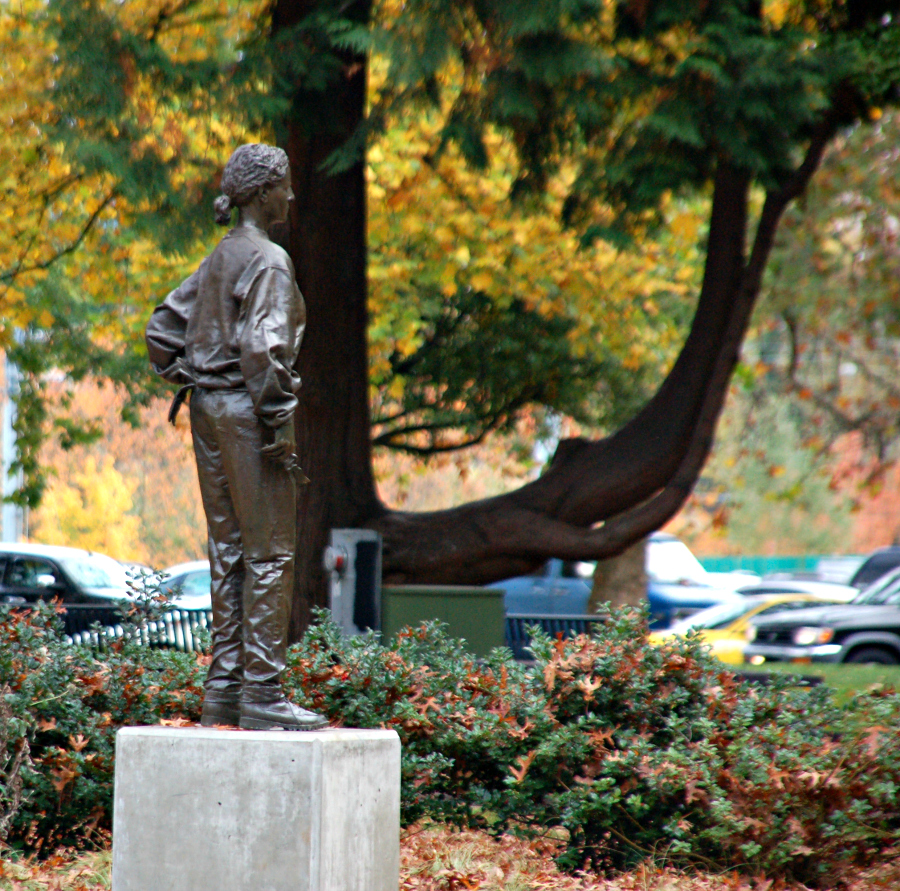
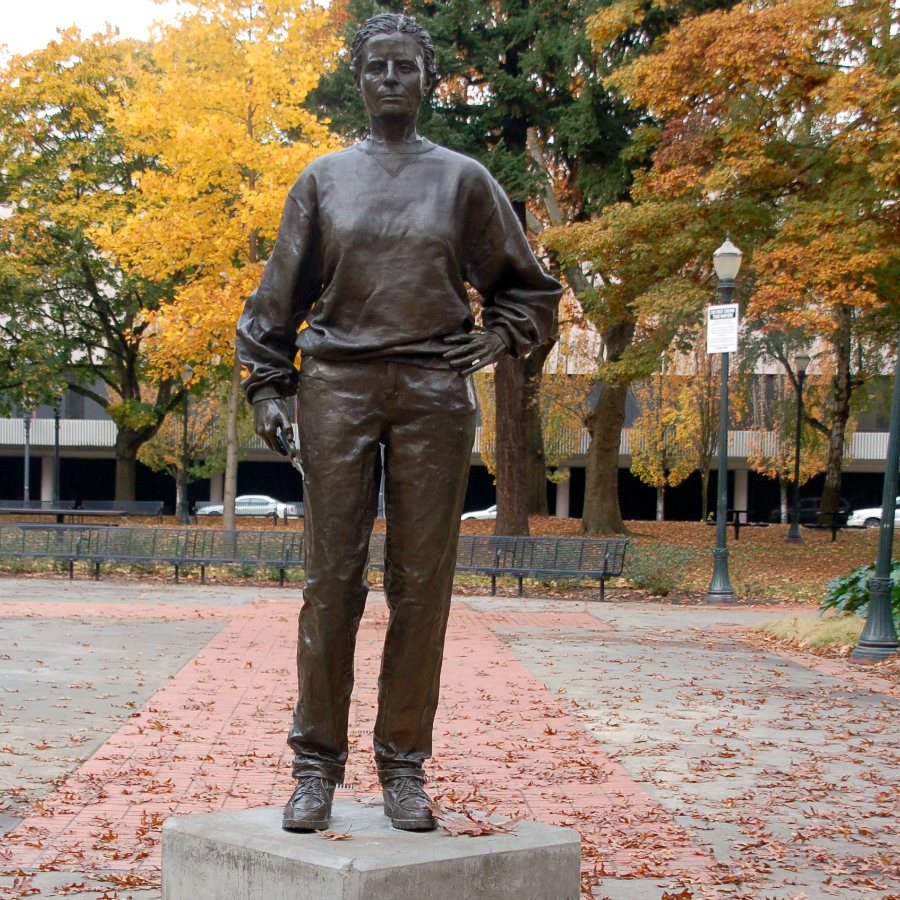
Garden shears in her right hand, she stands still, perhaps reflecting on her garden and the work she's accomplished. You can see her gardening gloves hanging from her left hip pocket in this photo. I found this description on the Internet: Standing female figure representing the neighborhood gardiner is actually a portrait of long-time community organizer, Carolyn Marks-Bax, who was selected for this honor by the neighborhood. I found it by accident, since gardener is misspelled.
  gardener_3_PM

I found on the Internet that the statue modeled after a local gardener, Carolyn Marks-Bax, who gardened near the park in the Sullivan's Gulch neighborhood. She may still garden there, I have no idea. When I go back some day to see this series of sculptures again, I plan to pay better attention to her.

Historical Information, from the City of Portland, about Holladay Park.

This park is named after Benjamin Holladay (1819-1887), known to many as "a sharpster, a con man, and a rake." He stirred things up wherever he went and was a bit of a dandy, dressing like a riverboat gambler. He was said to be "wholly destitute of fixed principles of honesty, morality, or common decency." In 1868 Holladay sold his stage coach business in California to Wells Fargo and moved to Portland to get involved in the railroad business. His goal was to build a rail line to California along the east side of the Willamette River. In order to do so, he spent a total of $55,000 in bribe money to help secure his company's endorsement. He also built two large hotels in the area where the park bearing his name is now located. Known as an extravagant spender, Holladay owned numerous mansions on both coasts and had over extended himself financially. He lost his railroad in 1876, and died in Portland in 1887.

Commissioned by the Lloyd Corporation and Pacific Power & Light in 1964, a concrete fountain featuring music and lights was installed in the park. Designed by Jack Stuhl, assisted by Ted Widing and Phillips Electrical, the musical fountain was favorite gathering place for park visitors. It was replaced in 2000, in conjunction with a major renovation of the park, by a spouting fountain designed by Tim Clemen and Murase Associates.

Three cast-bronze sculptures by artist Tad Savinar were added to the park as a percent-for-art project in 2000. Entitled Constellation, the project illustrates the connection between the personal front yard garden and the civic park garden through three distinct elements: a vase of cut flowers, an abstract molecule containing elements of a good neighborhood, and the figure of a home gardener, shears in hand. The objects in the molecule were selected by the Sullivan Gulch Neighborhood Association and the gardener was modeled after Carolyn Marks, a longtime neighborhood activist.

Tuesday, September 17, 2013

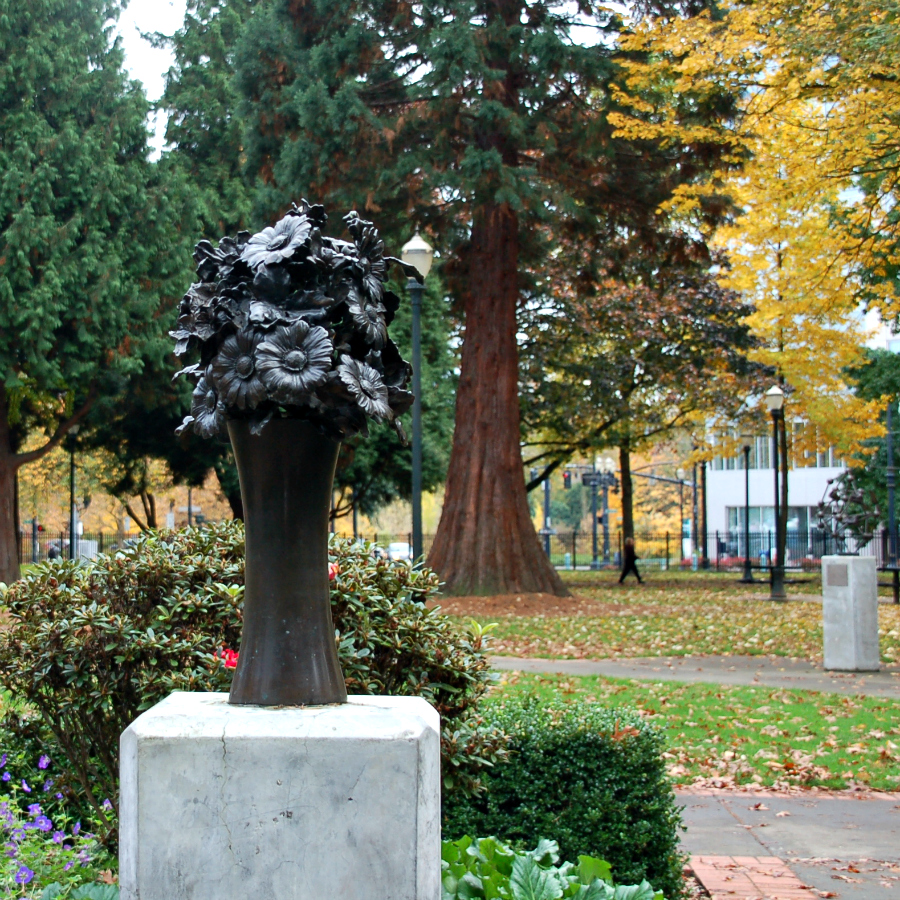
Constellation, three sculptures by Tad Savinar, 2000, Bronze -- No. 2, Flowers From a Neighborhood Garden

Click here for a trip to City Daily Photo, transporting you around the world every day.

Flowers From a Neighborhood Garden. From the plaque at the park: "These three sculptures are a visual representation of the connections between our civic gardens and our neighborhoods, and of the pivotal role we have as stewards of those relationships." This project was funded by the City of Portland's Percent for Art Program, administered by the Regional Arts & Culture Council.
  bouquet_2_PM

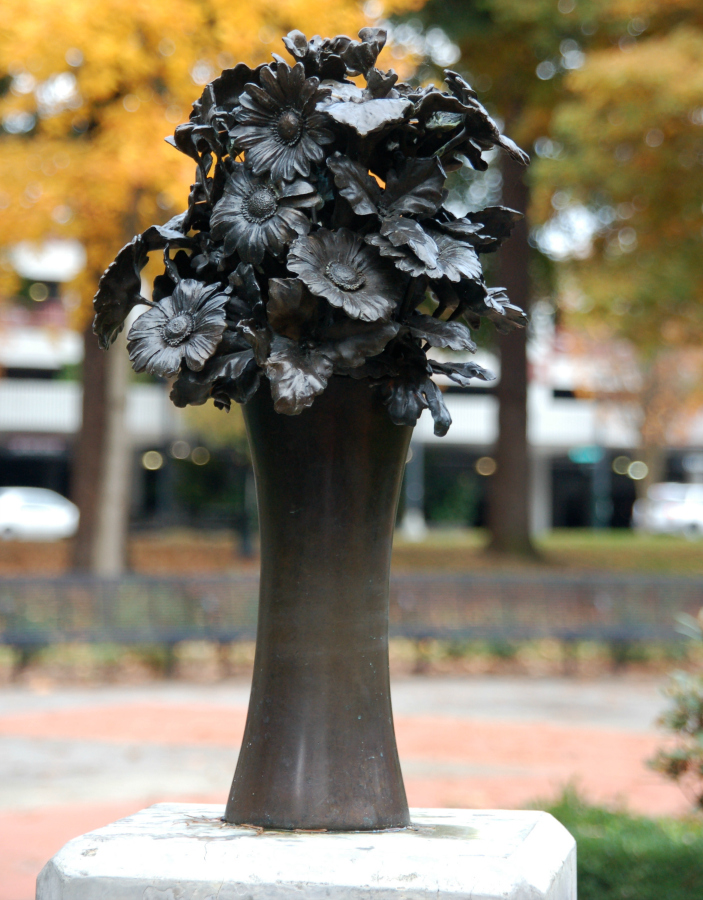
One view of the vase of cut flowers. I found this description on the Internet: A slender vase with a tall arrangement of flowers including hydrangeas and daisies.
  bouquet_1_PM

Another view of the cut flowers.

Historical Information, from the City of Portland, about Holladay Park.

This park is named after Benjamin Holladay (1819-1887), known to many as "a sharpster, a con man, and a rake." He stirred things up wherever he went and was a bit of a dandy, dressing like a riverboat gambler. He was said to be "wholly destitute of fixed principles of honesty, morality, or common decency." In 1868 Holladay sold his stage coach business in California to Wells Fargo and moved to Portland to get involved in the railroad business. His goal was to build a rail line to California along the east side of the Willamette River. In order to do so, he spent a total of $55,000 in bribe money to help secure his company's endorsement. He also built two large hotels in the area where the park bearing his name is now located. Known as an extravagant spender, Holladay owned numerous mansions on both coasts and had over extended himself financially. He lost his railroad in 1876, and died in Portland in 1887.

Commissioned by the Lloyd Corporation and Pacific Power & Light in 1964, a concrete fountain featuring music and lights was installed in the park. Designed by Jack Stuhl, assisted by Ted Widing and Phillips Electrical, the musical fountain was favorite gathering place for park visitors. It was replaced in 2000, in conjunction with a major renovation of the park, by a spouting fountain designed by Tim Clemen and Murase Associates.

Three cast-bronze sculptures by artist Tad Savinar were added to the park as a percent-for-art project in 2000. Entitled Constellation, the project illustrates the connection between the personal front yard garden and the civic park garden through three distinct elements: a vase of cut flowers, an abstract molecule containing elements of a good neighborhood, and the figure of a home gardener, shears in hand. The objects in the molecule were selected by the Sullivan Gulch Neighborhood Association and the gardener was modeled after Carolyn Marks, a longtime neighborhood activist.
Monday, September 16, 2013

Constellation, three sculptures by Tad Savinar, 2000, Bronze -- No. 1, Isolated Molecule for a Good Neighborhood

Click here for a trip to City Daily Photo, transporting you around the world every day.

Constellation: Isolated Molecule for a Good Neighborhood. From the plaque at the park: "These three sculptures are a visual representation of the connections between our civic gardens and our neighborhoods, and of the pivotal role we have as stewards of those relationships." This project was funded by the City of Portland's Percent for Art Program, administered by the Regional Arts & Culture Council.

First, photos of the atoms in the molecule, followed by a wide shot of the sculpture in Holladay Park, NE 11th Avenue & Holladay Street. At the end of the post you'll find historical information about the park and more details about the sculptures, from the City of Portland. I took these photos November 6, 2010.
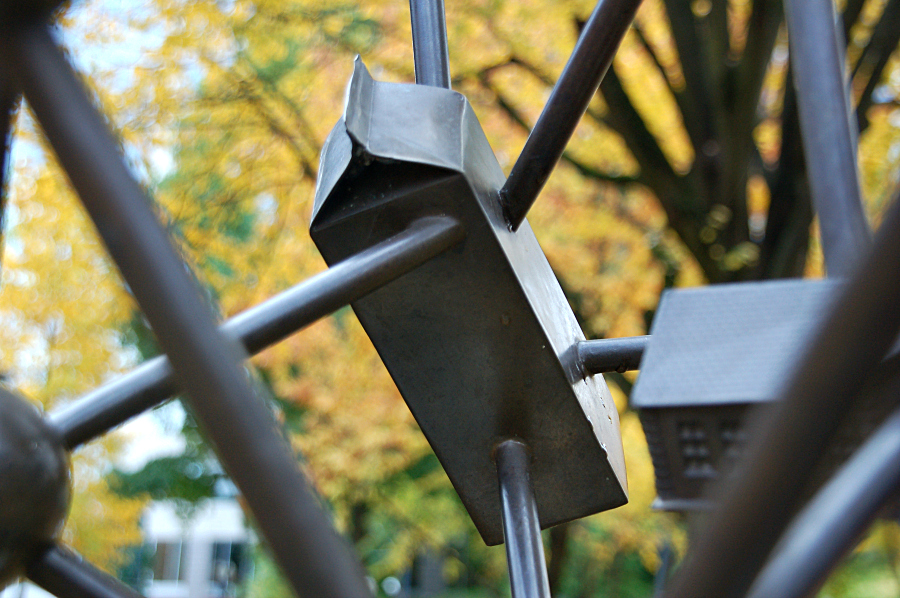
  molecule_milk_carton_PM

Milk carton.
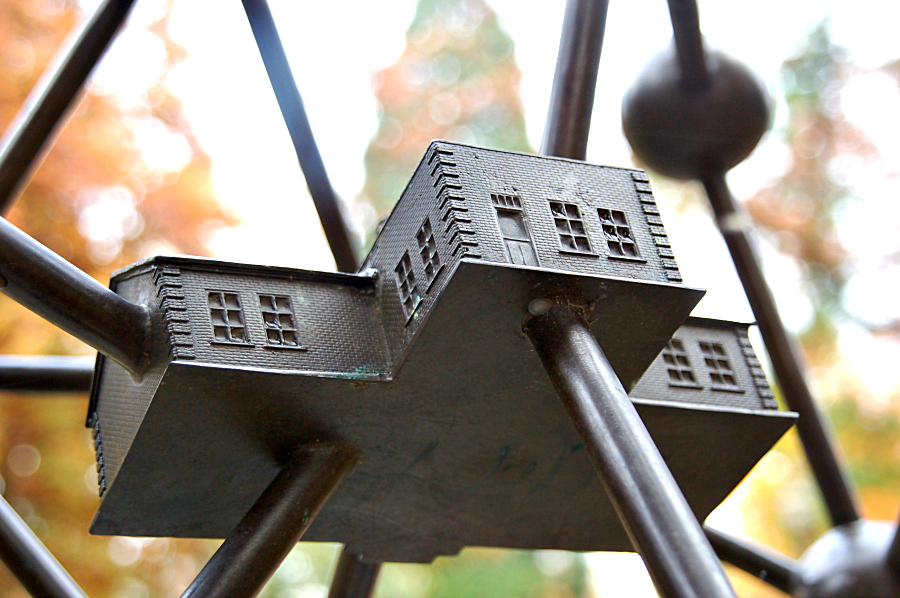
  molecule_school_milk_carton_PM

Milk carton and school building, front view.
  molecule_school_PM

School building, back view.
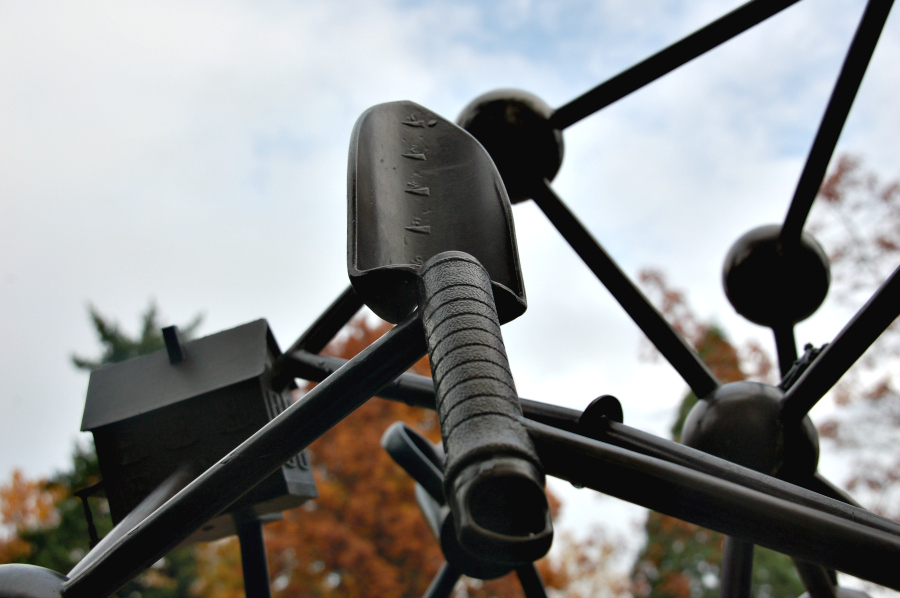
  molecule_garden_spade_house_two_story_PM

Garden spade and house, back view.
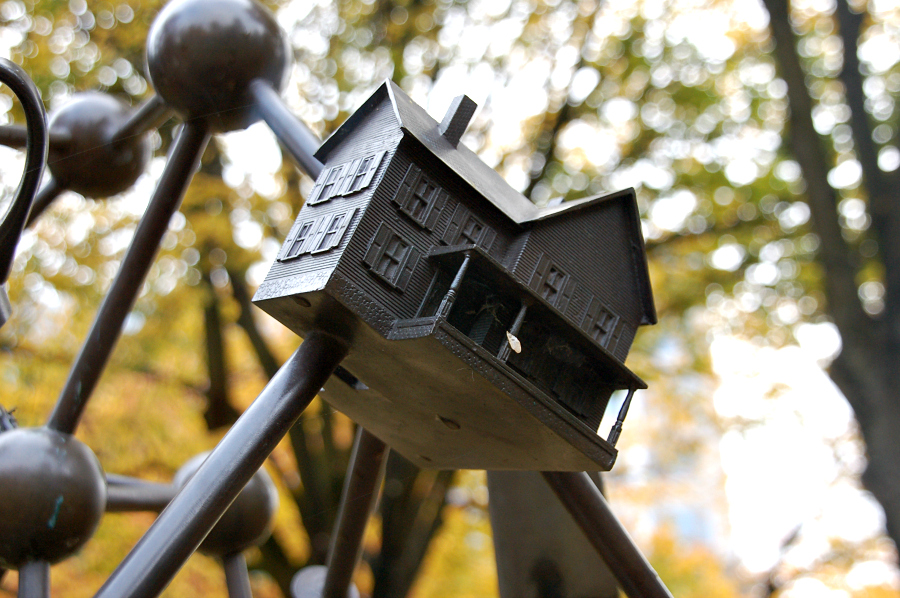
  molecule_house_two_story_porch_PM

House, front view.
  molecule_neighbors_PM

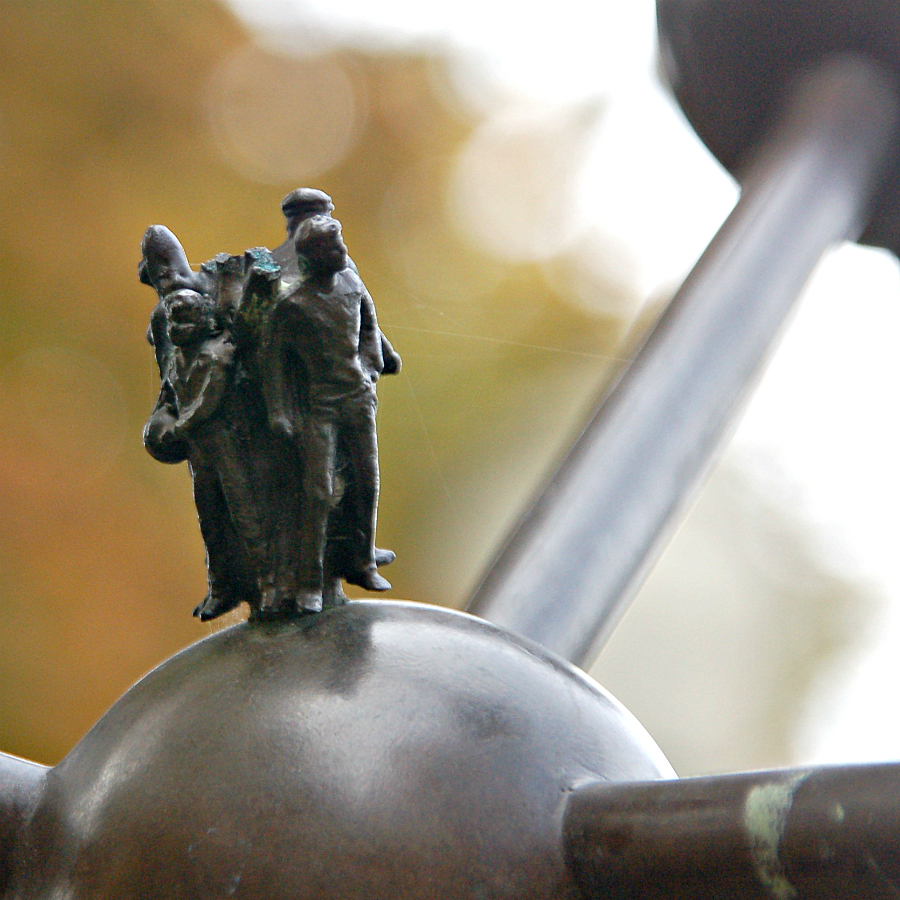
Family. Has something been broken off in the center of this group of figures? It's the turquoise color showing at the top of those structures that makes me wonder.
  molecule_wide_shot_PM

The entire sculpture, not the best angle for seeing it clearly, what with the nearby tree trunks being almost the same color. And I missed a few of the atoms: An enlarged structure of a molecule featuring atoms in the shape of a garden tool, a milk carton, a coffee mug, a bagel, a house, a school, a family, and trees --all the things that make a good neighborhood. Now I have a reason to go there again someday and take a longer look, see what else I can photograph.

Historical Information This park is named after Benjamin Holladay (1819-1887), known to many as "a sharpster, a con man, and a rake." He stirred things up wherever he went and was a bit of a dandy, dressing like a riverboat gambler. He was said to be "wholly destitute of fixed principles of honesty, morality, or common decency." In 1868 Holladay sold his stage coach business in California to Wells Fargo and moved to Portland to get involved in the railroad business. His goal was to build a rail line to California along the east side of the Willamette River. In order to do so, he spent a total of $55,000 in bribe money to help secure his company's endorsement. He also built two large hotels in the area where the park bearing his name is now located. Known as an extravagant spender, Holladay owned numerous mansions on both coasts and had over extended himself financially. He lost his railroad in 1876, and died in Portland in 1887.

Commissioned by the Lloyd Corporation and Pacific Power & Light in 1964, a concrete fountain featuring music and lights was installed in the park. Designed by Jack Stuhl, assisted by Ted Widing and Phillips Electrical, the musical fountain was favorite gathering place for park visitors. It was replaced in 2000, in conjunction with a major renovation of the park, by a spouting fountain designed by Tim Clemen and Murase Associates.

Three cast-bronze sculptures by artist Tad Savinar were added to the park as a percent-for-art project in 2000. Entitled Constellation, the project illustrates the connection between the personal front yard garden and the civic park garden through three distinct elements: a vase of cut flowers, an abstract molecule containing elements of a good neighborhood, and the figure of a home gardener, shears in hand. The objects in the molecule were selected by the Sullivan Gulch Neighborhood Association and the gardener was modeled after Carolyn Marks, a longtime neighborhood activist.