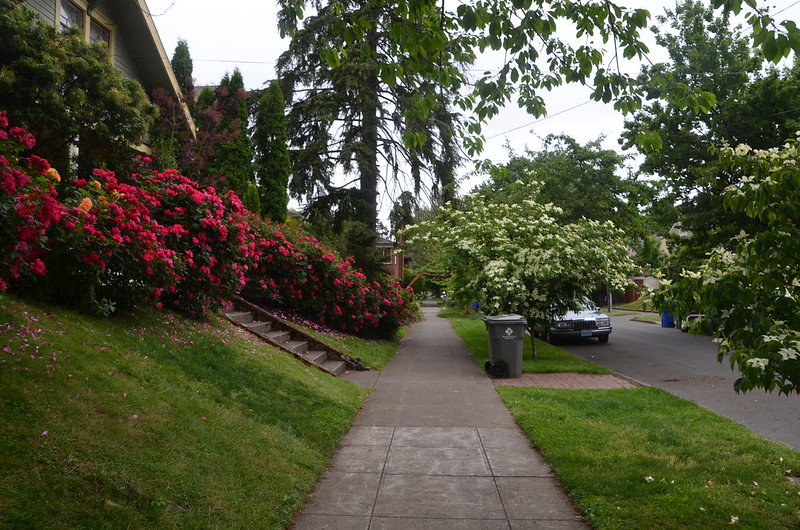
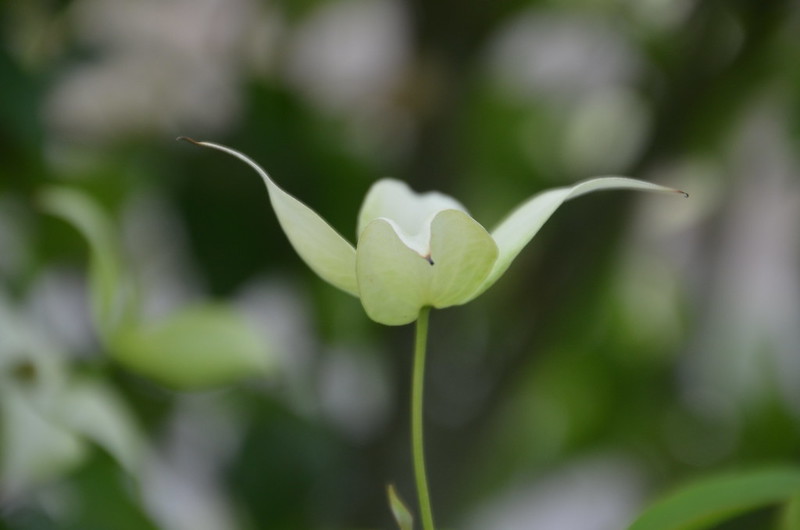
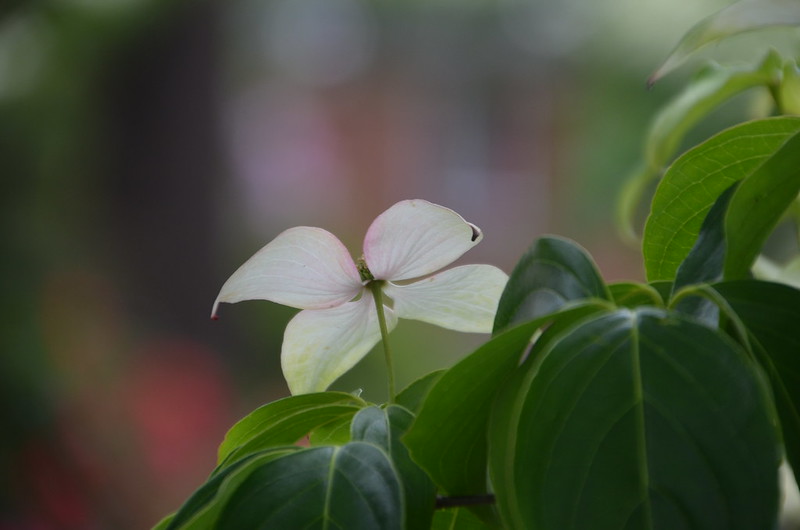
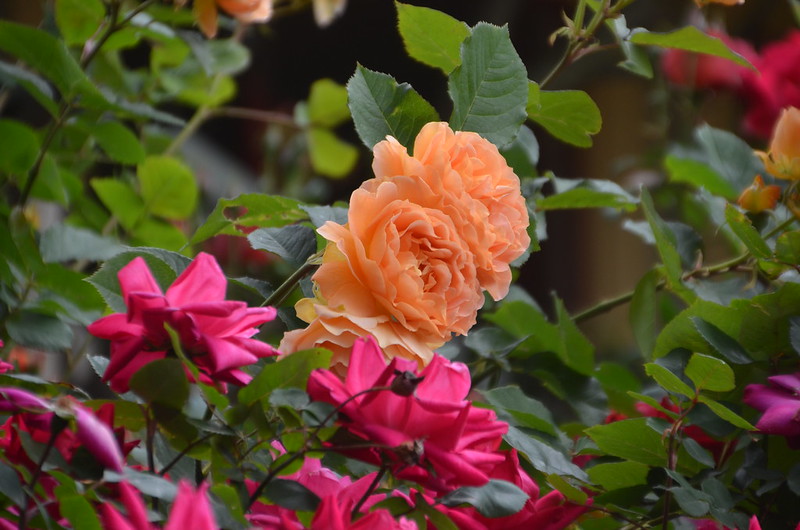
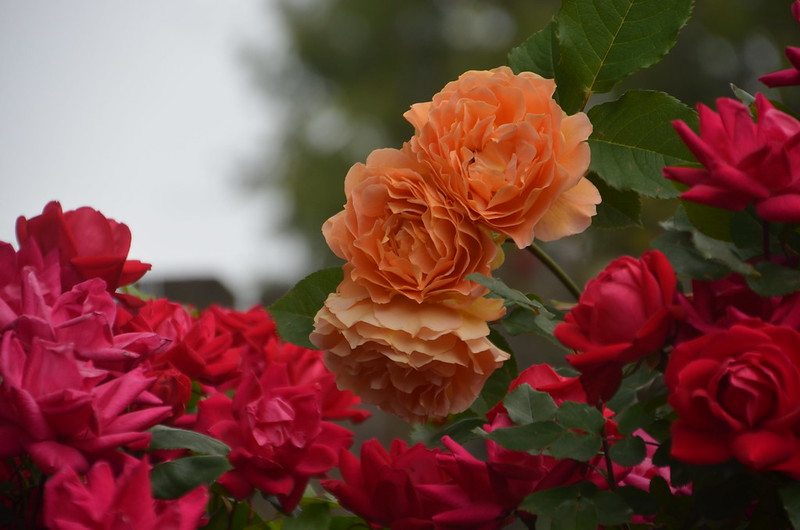
Last May, 2007, I started to notice these sort of muted, creamy, almost dogwood-shaped blossoms, practically at eye level as I walked down the slightly steep sidewalk from West Burnside to our apartment building. As time passed, I snapped these photos. I lucked up on finding out what the tree's name is, with the help of Google and Marsha at work--she's quite the gardener.

July, 2007

August, 2007.
Kousa Dogwood
From Wikipedia, the free encyclopedia
The Kousa Dogwood (Cornus kousa or Benthamidia kousa), also known as the Japanese Flowering Dogwood (Yamaboushi (ヤマボウシ, Yamaboushi?)), is a small deciduous tree 8-12 m tall, native to eastern Asia. Like most dogwoods, it has opposite, simple leaves, which are 4-10 cm long.
The tree is extremely showy when in flower, but the "flowers" are actually showy white bracts below the cluster of inconspicuous yellow-green flowers. The flowering is in late spring, weeks after it leafs out. It has a relatively upright habit, unlike the closely related Flowering Dogwood (Cornus florida) of eastern North America, which has a sprawling habit. It also differs from that in flowering about a month later, and in having pointed (not rounded) flower bracts.
The fruit is a globose pink to red compound berry 2-3 cm diameter, though these berries tend to grow larger towards the end of the season and some berry clusters that do not fall from the tree surpass 4 cm. It is edible; though lacking any interesting flavour to humans, it is taken by birds.
There are two varieties:
* Cornus kousa var. kousa. Leaves 4-7 cm; flower bracts 3-5 cm. Japan.
* Cornus kousa var. chinensis. Leaves 5-10 cm; flower bracts 4-6 cm. China.
It is resistant to the dogwood anthracnose disease, caused by the fungus Discula destructiva, unlike Flowering Dogwood, which is very susceptible and commonly killed by it; for this reason, Kousa Dogwood is being widely planted as an ornamental tree in areas affected by the disease. A number of hybrids between Kousa Dogwood and Flowering Dogwood have also been selected for their disease resistance and good flower appearance.