Showing posts with label St. Johns Bridge. Show all posts

Tuesday, August 25, 2015

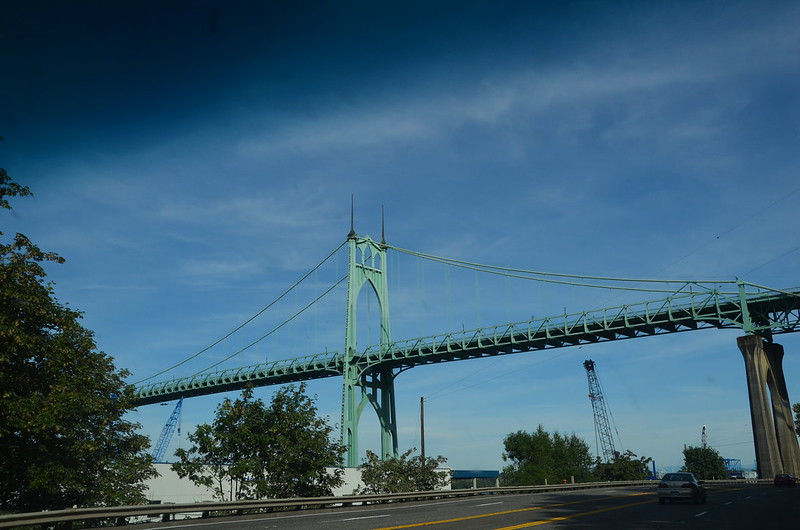
UPDATE and an on the road shot, thanks to Leland's Honda

UPDATE: I slept for a longer period of time last night! When I woke up at 4 a.m. in the recliner, I decided to try the bed and wedge pillow for my upper body and the memory foam pillow for my head. I really cannot tell you if I went back to sleep for real because every time I became aware of being in the bed, my brain was thinking the second I became aware of being there. For two hours this happened, although I believe I dozed some because what awoke me at 6 a.m. was the sound of my phone reminder to shut my windows. I have that reminder on perpetual repeat because, back when I was up and around, out and about, I needed it, just in case the temperature and air quality meant that I'd opened some windows. Don't want to leave them open and unlocked whenever I leave the apartment.

Anyway, I've been awake two hours and am about to take the morning meds, now reduced to just three and none of them are anti-nausea because I have NO nausea. Hooray! I have a headache, tiny amount of peripheral neuropathy in lower legs, none in hands right now. Hooray! We'll see how my energy level makes it through today, but, to tell you the truth, I feel like I could use a nap any minute. Thanks for your continued prayers, love, and concern. I feel every single one of them!

DSC_0086

The day after I learned that I needed that second surgery, the robot one on June 25 that removed the metastatic tumor from where it free-floated in my abdominal cavity, Leland and Rachel took me to Sauvie Island to pick blueberries. On the way back into the city, not a long drive at all, I took this photo through Leland's windshield. It's impossible to ride by the St. Johns Bridge and not want to photograph it, y'all.There's another one of these gorgeous supports on the eastern side of the Willamette River. Thanks for the chance to get this photo, Leland and Rachel! I had a great time picking blueberries and being with you two!

Sunday, December 4, 2011

Sunday Bridges: St. Johns Bridge

See lots of Sunday Bridges here.

DSC_0454p
A US Navy ship crossed underneath the St. Johns Bridge on the Willamette River, June 9, 2011, during Rose Festival Fleet Week.

Carries U.S. Route 30 Bypass
Crosses Willamette River
Locale Portland, Oregon
Maintained by Oregon DOT
Design Suspension bridge, Art Deco
Total length 2,067 ft (630 m)
Longest span 1,207 ft (369 m)
Clearance below 205 ft (62 m)
Opened June 13, 1931

From Wikipedia:

The St. Johns Bridge is a steel suspension bridge that spans the Willamette River in Portland, Oregon, USA, between the St. Johns neighborhood and the northwest industrial area around Linnton. It is the only suspension bridge in the Willamette Valley and one of three public highway suspension bridges in Oregon. It is also the farthest north of any bridge on the Willamette.

The bridge has two 408 ft (124 m) tall Gothic towers, a 1,207 ft (368 m) center span and a total length of 2,067 ft (630 m). The adjacent park and neighborhood of Cathedral Park, Portland, Oregon are named after the Gothic Cathedral-like appearance of the bridge towers. It is the tallest bridge in Portland, with 400 ft (122 m) tall towers and a 205 ft (62 m) navigational clearance.
By 2001, average traffic on the bridge was 23,800 vehicles/day.

History:

Designed by internationally renowned engineer David B. Steinman (1886-1960) and Holton D. Robinson, of New York, the St. Johns was the longest suspension-type bridge west of the Mississippi River at the time of construction. It is the only major highway suspension bridge in the Willamette Valley and one of only three major highway suspension bridges in Oregon.

At the time of the proposal to build the bridge, the area was served by a ferry that carried 1000 vehicles a day. The proposal for a bridge was initially met with skepticism in Multnomah County, since St. Johns and Linnton were over five miles (8 km) from the heart of the city, and local business owners had minimal political clout. But after a lobbying effort that included a vaudeville-style show performed at grange halls and schools throughout the county, voters approved a $4.25 million bond for the bridge in the November 1928 elections. Initially a cantilever bridge was proposed, but a suspension bridge was selected due to an estimated $640,000 savings in construction costs.

The construction of the bridge began a month before the Stock Market Crash of 1929 and provided many county residents with employment during the Great Depression. Because of its proximity to the Swan Island Municipal Airport, some government officials wanted the bridge painted yellow with black stripes. County officials waited until St. Patrick's Day 1931 to announce that it would be painted green.

Dedication of the bridge was put off for one month in order to make it the centerpiece of the 23rd annual Rose Festival. It was dedicated on June 13, 1931, and during the ceremony, the bridge engineer, David B. Steinman said: "A challenge and an opportunity to create a structure of enduring beauty in the God-given wondrous background was offered us when were asked to design the bridge. It is the most beautiful bridge in the world we feel.”

The bridge was built within 21 months and one million dollars under budget. At the time of its completion, the bridge had:
the highest clearance in the nation, the longest prefabricated steel cable rope strands, the tallest steel frame piers of reinforced concrete, the first application of aviation clearance lights to the towers, and longest suspension span west of Detroit, Michigan.

In the summer of 1949, 15-year-old high school student Thelma Taylor was abducted and held by her captor, Morris Leland, under the east side of the bridge (which was undeveloped at the time, now the location of Cathedral Park, Portland, Oregon), and was eventually murdered there. The crime shocked the city and her killer was apprehended and put to death.

It was not until the Marquam Bridge in 1966 that another non-movable bridge would be built in Portland.

By the 1970s, the bridge had been allowed to deteriorate, and cash-strapped Multnomah County asked the state to take over maintenance. Initially, the state declined, since it was also suffering from a lack of funds. But pressure from an association of county governments forced the state government to take it over on August 31, 1975. A county official estimated the move saved them $10 million during the first ten years of state maintenance.

In summer 1987, General Motors filmed the introductory commercial for the 1988 Buick Regal in Portland, Oregon and vicinity, including the St. John's bridge, the Astoria-Megler Bridge, and on the Columbia Gorge.

Portions of the east approaches and east span were repainted beginning in 1987 and completed in 1994. In 1999 the Oregon Department of Transportation announced a $27 million rehabilitation project that began in March 2003 and was completed in the fall of 2005. Included in the project was replacement of the deck, repainting of the towers, water-proofing the main cables, lighting upgrades, and improving access for bicycle and pedestrian traffic. By November 2004, renovation costs soared to $38 million, due mostly to the need to replace nearly half of the 210 vertical suspender cables. During the project, the bridge sidewalks were closed at all times. In addition, the entire bridge was closed at night and continuously for a month. The newly refurbished bridge was rededicated on September 17, 2006.

In Pop Culture

In the film Pay It Forward, Jerry (James Caviezel), a homeless man who was the first person helped by Trevor (Haley Joel Osment), talks a woman out of jumping off the St. Johns Bridge.

Friday, September 23, 2011

A few more views from on high

August 23, the afternoon found Milton, Kay and me in downtown Portland on the 30th floor of the Big Pink, at the Portland City Grill. After a snack and a drink, I stood up and walked from the bar to the dining room to take a few more photos.

DSC_0100p_exposure_altered_sharpened
Looking northeast across the Willamette River. The rust-colored bridge is the Broadway Bridge. The sweeping arched bridge is the Fremont Bridge. And in the foreground is the magnificent Union Station which is undergoing some sort of work on its exterior. I altered the photo in Picnik with the exposure and the sharpness tools.

DSC_0104p_HDRish_frame_800
Looking more north than east across the Pearl in the forefront and a sort of light industrial area that brackets the train tracks as the head north out of downtown Portland, not far from the river. See there in the distance where the hills meet the river? Two dark, upright shapes? Just to the left of the leftmost one, there's a dimmer upright shape. And between the two dark, upright shapes there is a dim shape that goes from the dimmer upright shape on to in between the two dark, upright shapes and parallel with the surface of the river. OK. The two dark, upright shapes are part of the Burlington Northern Railroad Bridge, a truss bridge with a vertical lift. The dimmer upright shape and the dim shape parallel with the river are part of the St. Johns Bridge, a photo of which is included in my September 19 post. When I rode the SP 4449 on July 3, we crossed the Willamette River using that railroad bridge. Milton and Kay crossed it as they entered Portland. I altered this photo with the HDR-ish effect and put a frame around it.

DSC_0112p_exposure_sharpen
Looking straight down to the east at Voodoo Doughnuts' original location on the corner of SW 3rd Avenue and SW Ankeny Street. See the tiny people in line from the red truck, along the front of the building and ending almost beneath the pink sign? Those are a few people in line for doughnuts in the middle of the afternoon--that's the hold that Voodoo has on folks, some folks anyway; to tell you the truth there are usually a whole lot more people in line. And the small, almost school-bus-colored items side-by-side in SW Ankeny are actually wooden picnic tables, while the black and white spots farther on are actually umbrellas over additional picnic tables. Portland decided in late July to make this portion of SW Ankeny car-free, a sort of patio area. The bit of a bridge that you can see on the left is the Burnside Bridge. See the MAX train in the trees, about two thirds of the way up from the bottom of the photo? It's crossing alongside the Skidmore Fountain in what's known as Ankeny Plaza. All through those trees where the three cars are parked you'll find the Portland Saturday Market which continues to the white arches topped with bricks and across the street and beneath the rest of the trees. The gray area between the trees and the river is the sort of plaza just south of the rest of the Saturday Market.

Monday, September 19, 2011

Out and about with Milton and Kay, Tuesday, August 23

Up early, coffee and protein drink, and then to the bus for a ride north of the apartment to try out the Cadillac Cafe on NE Broadway. I found it on the Internet and thought it looked worth a shot, plus it was near a Goodwill that we didn't make on Monday, one we could walk to after brunch.

DSC_0036p
While we waited across the street from the Lloyd Center, a great big shopping center, to transfer to our third and final bus for the trip, this hard-working young woman road through the intersection on her Soup Cycle.

DSC_0037p
We boarded the bus, and on the way to NE Broadway, I took this photo of another busy bicyclist.

Here you see my glass of orange juice, Milton's omelette, and my breakfast. Kay got the same thing I did, but with fried eggs. I forgot to take a photo of her plate. I did get two photos of the Cadillac that has its own special space inside the cafe.
DSC_0039pDSC_0041DSC_0042DSC_0043DSC_0044

DSC_0048
We walked to the Goodwill after we ate, then walked over to the Barnes & Noble at Lloyd Center so that Milton and Kay could look for a DVD, "Oregon Splendor," that they'd watched with friends at home. They wanted their own copy to take back to Mississippi with them. There was one copy of it in the store. On the way to Lloyd Center we walked by this sculpture, "In the Tree Tops" by Margarita Leon.

DSC_0065p
After we left the shopping center, we walked south to the MAX stop so that we could get on board and ride to catch MAX Yellow Line at the Rose Garden and then ride north to Lombard where we boarded a bus that we rode to St. Johns. We got off there and walked a couple of blocks so that we could see the St. Johns Bridge. It's a beautiful bridge.

DSC_0074p
Soon we retraced our route, bus back to MAX and got off downtown so that we could make our way to the 30th floor of the Big Pink and hopefully get to sit at the windows in the bar at the Portland City Grill where we planned to have something to drink and a little snack to tide us over until supper time. From the MAX car, I took this photo of an art car at a service station. It's a hoot!

DSC_0076
Speaking of art, here is a photo of two of the cairns on NW 5th Avenue which are part of the public art that one finds here and there along the MAX lines. I took it from inside the MAX car.

Here's what the TriMet pamphlet has to say about the Cairns:

Christine Bourdette, Cairns, 2008 Silver ledgestone, NW 5th and 6th between Irving and Glisan
My inspiration for Cairns came from the man- made stacks of stones that have historically served as landmarks for navigation, memorials, rituals and commemorative markers all over the world. Travelers on cross-country hiking trails traditionally add stones to cairns as they pass, resulting in animated and sometimes precarious stacks of rocks and pebbles. This evidence of our comings and goings, often in rather comical human form, signify safety and reassurance in the wilderness. In the urban wilderness, finding one’s way through the various stages of hurry-up-and- wait is just as significant. I am fascinated with all the ways my fellow citizens and I learn how to navigate our surroundings. My specific intention for these stacked stone forms was to mark the path to the light rail stations as well as to celebrate points of arrival and departure.
Masonry: Cliff Townsend Masonry, Inc. Oregon City, OR

Oh, before I forget. We got a table at the windows. Come back tomorrow for the views!

Sunday, July 24, 2011

Sunday Bridges, the St. Johns Bridge over the Willamette River

DSC_0542p
This is a portion of the St. Johns Bridge, seen from the Burlington Northern Railroad Bridge, a truss bridge with a vertical left, as the SP 4449 steamed across the Willamette River on July 3, on its way to Wishram, Washington. I took the photo from my seat in the dome car, looking to the north. On the left you see just a bit of the upper structure of the railroad bridge and some of the rivets.

The St. Johns Bridge is a steel suspension bridge over the Willamette River, connecting the St. Johns neighborhood and the Northwest Industrial area around Linnton, another Portland neighborhood; Linnton extends into unincorporated Multnomah County, outside the city limits of Portland. It is the only suspension bridge in the Willamette Valley and one of three public highway suspension bridges in Oregon. There are two gothic towers, not just one as you see in the photo, both of which are 408 feet tall. It has a 1,207 foot center span and a total length of 2,067 feet. The St. Johns Bridge is the tallest one in Portland, with a navigational clearance of 205 feet.

Friday, December 17, 2010

Which one of these do you think better?

Two treatments of the same photo of the St. Johns Bridge, which crosses the Willamette River. See below for some info about a truly beautiful bridge.

DSC_0029p_neon_green_p
The original photo is below. This one has been framed and made into neon, using a green, at Picnik.

DSC_0029p
Framed, Picniked a little bit in the exposure, and resized to fit, I hope, on the blog page nicely.

Which one do you prefer? Would you tell me why? Thanks.

Here's some information on the bridge, from Wikipedia:

he St. Johns Bridge is a steel suspension bridge that spans the Willamette River in Portland, Oregon, USA, between the St. Johns neighborhood and the northwest industrial area around Linnton. It is the only suspension bridge in the Willamette Valley and one of three public highway suspension bridges in Oregon.

The bridge has two 408 ft (124 m) tall Gothic towers, a 1,207 ft (368 m) center span and a total length of 2,067 ft (630 m). The adjacent park and neighborhood of Cathedral Park, Portland, Oregon are named after the Gothic Cathedral-like appearance of the bridge towers. It is the tallest bridge in Portland, with 400 ft (122 m) tall towers and a 205 ft (62 m) navigational clearance.
By 2001, average traffic on the bridge was 23,800 vehicles/day.

History

At the time of the proposal to build the bridge, the area was served by a ferry that carried 1000 vehicles a day. The proposal for a bridge was initially met with skepticism in Multnomah County, since St. Johns and Linnton were over five miles (8 km) from the heart of the city, and local business owners had minimal political clout. But after a lobbying effort that included a vaudeville-style show performed at grange halls and schools throughout the county, voters approved a $4.25 million bond for the bridge in the November 1928 elections. Initially a cantilever bridge was proposed, but a suspension bridge was selected due to an estimated $640,000 savings in construction costs.

The construction of the bridge began a month before the Stock Market Crash of 1929 and provided many county residents with employment during the Great Depression. Because of its proximity to the Swan Island Municipal Airport, some government officials wanted the bridge painted yellow with black stripes. County officials waited until St. Patrick's Day 1931 to announce that it would be painted green.

Dedication of the bridge was put off for one month in order to make it the centerpiece of the 23rd annual Rose Festival. It was dedicated on June 13, 1931, and during the ceremony, the bridge engineer, David B. Steinman said: “A challenge and an opportunity to create a structure of enduring beauty in the God-given wondrous background was offered us when were asked to design the bridge. It is the most beautiful bridge in the world we feel.”

The bridge was built within 21 months and one million dollars under budget. At the time of its completion, the bridge had:
the highest clearance in the nation, the longest prefabricated steel cable rope strands, the tallest steel frame piers of reinforced concrete, the first application of aviation clearance lights to the towers, and longest suspension span west of Detroit, Michigan.

In the summer of 1949, 15-year-old high school student Thelma Taylor was abducted and held by her captor, Morris Leland, under the east side of the bridge (which was undeveloped at the time, now the location of Cathedral Park, Portland, Oregon), and was eventually murdered there. The crime shocked the city and her killer was apprehended and put to death.

It was not until the Marquam Bridge in 1966 that another non-movable bridge would be built in Portland.

By the 1970s, the bridge had been allowed to deteriorate, and cash-strapped Multnomah County asked the state to take over maintenance. Initially, the state declined, since it was also suffering from a lack of funds. But pressure from an association of county governments forced the state government to take it over on August 31, 1975. A county official estimated the move saved them $10 million during the first ten years of state maintenance.

In summer 1987, General Motors filmed the introductory commercial for the 1988 Buick Regal in Portland, Oregon and vicinity, including the St. John's bridge, the Astoria-Megler Bridge, and on the Columbia Gorge.

Portions of the east approaches and east span were repainted beginning in 1987 and completed in 1994.

In 1999 the Oregon Department of Transportation announced a $27 million rehabilitation project that began in March 2003 and was completed in the fall of 2005. Included in the project was replacement of the deck, repainting of the towers, water-proofing the main cables, lighting upgrades, and improving access for bicycle and pedestrian traffic. By November 2004, renovation costs soared to $38 million, due mostly to the need to replace nearly half of the 210 vertical suspender cables. During the project, the bridge sidewalks were closed at all times. In addition, the entire bridge was closed at night and continuously for a month. The newly refurbished bridge was rededicated on September 17, 2006.

Thursday, April 29, 2010

St. Johns Bridge, north of where Mama and I live, up Highway 30

DSC_0024p
I took this photo on April 11, the day that Mama and I went for a ride in the rented car. Since we'd yet to see the St. Johns Bridge but had heard how beautiful it was, we headed up Highway 30 to find it. As we rode along, I felt increasingly awful, the allergy difficulties setting in full force. Believe it or not, I couldn't make myself get out of the car to take many photos. Luckily, I found a suitable place o to pull over to take photos. One of these days I'm going to ride the bus up there and get off to see if I can find some spots to take more photos. I took a few more that Sunday.

DSC_0029
Huge hardly describes these supports or whatever they're officially called.

DSC_0030
See these men beside them and you can really tell for sure.

Here's info about the bridge, that I found on the World Wide Web: The St. Johns Bridge is a steel suspension bridge that spans the Willamette River in Portland, Oregon, USA, between the St. Johns neighborhood and the northwest industrial area around Linnton. It is the only suspension bridge in the Willamette Valley and one of three public highway suspension bridges in Oregon.
The bridge has two 408 ft (124 m) tall Gothic towers, a 1,207 ft (368 m) center span and a total length of 2,067 ft (630 m). The adjacent park and neighborhood of Cathedral Park, Portland, Oregon are named after the Gothic Cathedral-like appearance of the bridge towers. It is the tallest bridge in Portland, with 400 ft (122 m) tall towers and a 205 ft (62 m) navigational clearance.
By 2001, average traffic on the bridge was 23,800 vehicles/day.

History

At the time of the proposal to build the bridge, the area was served by a ferry which carried 1000 vehicles a day. The proposal for a bridge was initially met with skepticism in Multnomah County, since St. Johns and Linnton were over five miles (8 km) from the heart of the city, and local business owners had minimal political clout. But after a lobbying effort that included a vaudeville-style show performed at grange halls and schools throughout the county, voters approved a $4.25 million bond for the bridge in the November 1928 elections.[4] Initially a cantilever bridge was proposed, but a suspension bridge was selected due to an estimated $640,000 savings in construction costs.
The construction of the bridge began a month before the Stock Market Crash of 1929 and provided many county residents with employment during the Great Depression. Because of its proximity to the Swan Island Municipal Airport, some government officials wanted the bridge painted yellow with black stripes. County officials waited until St. Patrick's Day 1931 to announce that it would be painted green.
Dedication of the bridge was put off for one month in order to make it the centerpiece of the 23rd annual Rose Festival. It was dedicated on June 13, 1931, and during the ceremony, the bridge engineer, David B. Steinman said:
"A challenge and an opportunity to create a structure of enduring beauty in the God-given wondrous background was offered us when were asked to design the bridge. It is the most beautiful bridge in the world we feel.”
The bridge was built within 21 months and one million dollars under budget. At the time of its completion, the bridge had:
the highest clearance in the nation,
the longest prefabricated steel cable rope strands,
the tallest steel frame piers of reinforced concrete,
the first application of aviation clearance lights to the towers, and
longest suspension span west of Detroit, Michigan.

It was not until the Marquam Bridge in 1966 that another non-movable bridge would be built in Portland.
By the 1970s, the bridge had been allowed to deteriorate, and cash-strapped Multnomah County asked the state to take over maintenance. Initially, the state declined, since it was also suffering from a lack of funds. But pressure from an association of county governments forced the state government to take it over on August 31, 1975. A county official estimated the move saved them $10 million during the first ten years of state maintenance.
In summer 1987, General Motors filmed the introductory commercial for the 1988 Buick Regal in Portland, Oregon and vicinity, including the St. John's bridge, the Astoria-Megler Bridge, and on the Columbia Gorge.[citation needed]
Portions of the east approaches and east span were repainted beginning in 1987 and completed in 1994.
In 1999 the Oregon Department of Transportation announced a $27 million rehabilitation project that began in March 2003 and was completed in the fall of 2005. Included in the project was replacement of the deck, repainting of the towers, water-proofing the main cables, lighting upgrades, and improving access for bicycle and pedestrian traffic. By November 2004, renovation costs soared to $38 million, due mostly to the need to replace nearly half of the 210 vertical suspender cables. During the project, the bridge sidewalks were closed at all times. In addition, the entire bridge was closed at night and continuously for a month. The newly refurbished bridge was rededicated on September 17, 2006.